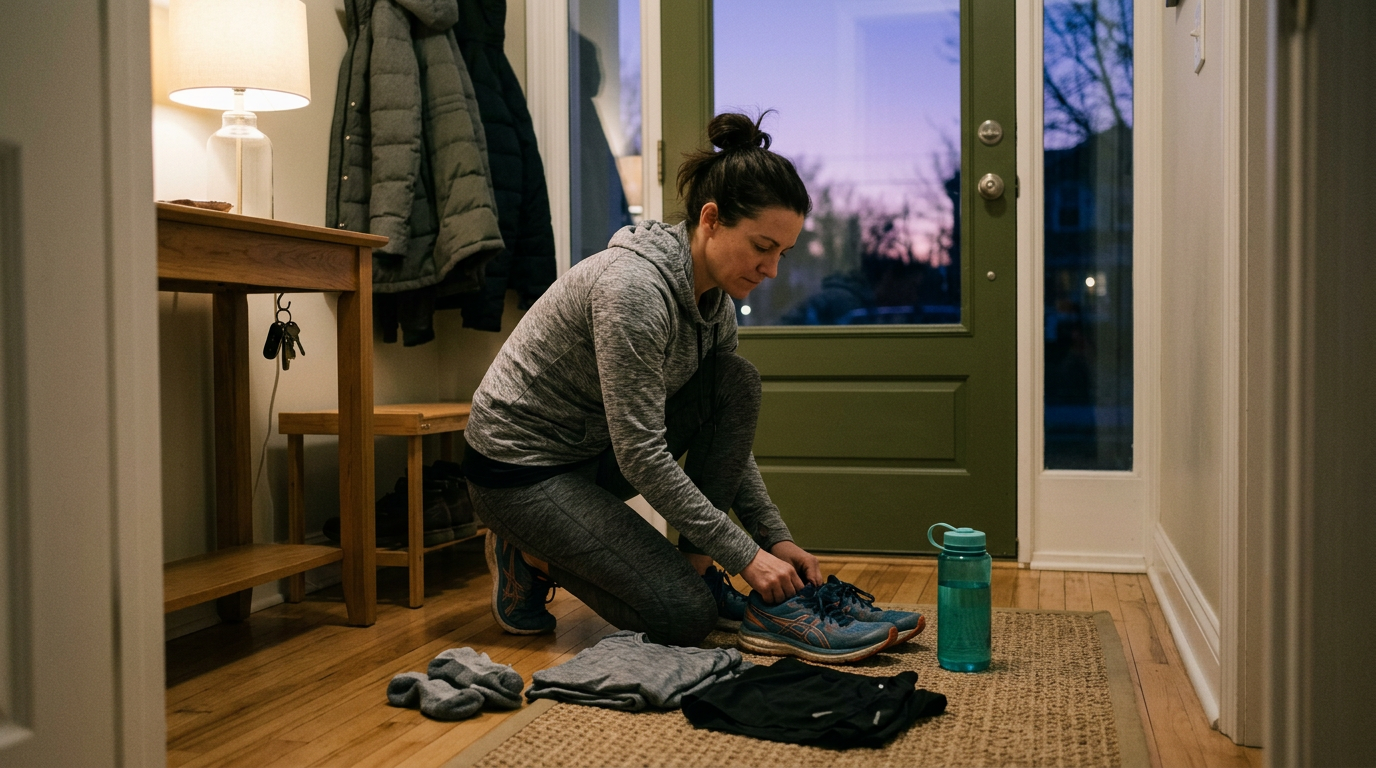
Think about the changes that actually held in your life. The training you kept up, the habit that survived, the thing you got good at. Somewhere in almost every one of those stories is a person: someone who trained with you, checked in, expected you at seven, or simply knew what you were attempting. Now think about the resolutions that quietly died. Most of them were private. That pattern reflects something structural instead of a personal weakness, and understanding why it happens tells you how to make the next change one of the ones that lasts.
Why does change hold better with other people?
Because private intentions have nothing holding them in place when motivation drops. Another person adds accountability, a schedule you cannot silently move, a source of encouragement during the difficult middle, and a witness who makes the new behavior part of how you are known.
Each of those does distinct work. Accountability makes skipping visible. A shared schedule converts an intention into an appointment. Encouragement carries you through the weeks where progress goes quiet. And being known as someone who does this quietly reshapes your own self image, which our guide to identity based change covers as the mechanism that makes behavior durable.
None of this requires an audience or a public commitment. A single person who genuinely knows what you are working on will supply most of the effect on their own.
What does the research say about social influence?
Social connection is one of the most consistently protective factors in health research, and behaviors spread through relationships. The company you keep shapes what feels normal, which is why environments and groups tend to outperform individual willpower over long periods.
The health evidence is substantial. A large analysis published in PLoS Medicine pooled data across many studies and found strong social relationships associated with substantially better survival, placing connection alongside established medical risk factors in importance.
The mechanism relevant to change is normalization. What the people around you do quietly sets your sense of what is ordinary, so a group where everyone trains makes training unremarkable, and a group where nobody reads quietly makes reading feel like an affectation you should probably explain.
What kind of support actually helps?
Support works when it is specific, recurring, and free of judgment. Someone who knows exactly what you are attempting, who meets you on a fixed schedule, and who responds to a lapse with curiosity will help you far more than a cheerleader offering general encouragement who never asks a single concrete question.
Frequency beats intensity here as well. A short weekly check with someone who knows the specifics does more than a long conversation every few months, because the check arrives while the week is still correctable.
Vague support fails predictably. Telling a friend you want to get healthier gives them nothing to ask about, and the conversation goes nowhere useful. Telling them you are walking four mornings a week and would like to be asked about it on Fridays gives them something specific to hold.
The response to failure matters as much as the response to success. Support that shames a lapse makes people hide the next one, which is how a struggling habit becomes a secret and then becomes nothing. The useful question after a missed week is what got in the way, since that is a design question with an answer.
How do you find people when you have none for this?
Look for groups organized around the activity itself. Classes, clubs, training groups, and communities built around a shared practice supply both structure and company at the same time, which works far more reliably than trying to persuade an existing friend to take up your new interest alongside you.
The advantage is that you never have to ask anyone for anything. A class expects you at seven on Tuesdays whether or not you feel like arriving, and the other people there are pursuing the same thing for their own reasons, which removes the awkwardness of recruiting a friend into your project.
This is why running clubs, choirs, climbing gyms, and language classes work so well. The schedule exists whether or not you feel motivated, other people are already doing the thing, and attendance quietly becomes part of your week.
One friend also works if you choose the arrangement carefully. Pick someone reliable, agree on something concrete, and set a recurring time. Our guide to making friends as an adult covers building these relationships when your current circles offer nobody obvious.
What if the people around you pull the other way?
Then find at least one relationship that supports the change, because sustaining a new behavior against uniform social pressure is genuinely difficult and rarely worth attempting on willpower alone. Add a supportive environment to your life instead of trying to convert the people you already have around you.
This situation is common and rarely discussed honestly. Households, friend groups, and workplaces develop norms, and someone changing a habit can feel like an implicit criticism of everyone who keeps it, which produces resistance that has very little to do with you.
Expect much of it to be affectionate instead of hostile. The partner who keeps offering you a drink, the colleagues who tease you about leaving early to train: most of that comes from people who like you and would prefer you unchanged, since your change asks a quiet question about their own habits.
The workable move is addition. Keep your existing relationships and add one group or one person aligned with the change, so the new behavior has somewhere to be normal. Over time, results tend to soften the resistance far more effectively than arguments ever did.
How do you support someone else well?
Ask what specifically they are working on and how they want to be supported. Then be consistent about it, stay curious after a lapse, and notice progress out loud, since most people receive far less acknowledgement than they need to keep going.
The mistake most of us make is supplying the support we would want instead of the support they asked for. Some people want a training partner, others want a weekly question, and others want someone who simply knows and says nothing until asked.
Ask once and then honor the answer. People change what they need over time, so a short check every few months about whether the arrangement still helps keeps you useful instead of merely well intentioned.
Noticing out loud is the underrated part. Telling someone you have observed them keeping this up for two months gives them evidence about who they are becoming, which our guide to self efficacy describes as the belief that carries people through difficulty.
Where does this fit in a mental longevity practice?
Every capacity that keeps a mind sharp for decades depends on practices repeated for years, and years are longer than motivation lasts. Community is what carries a practice through the stretches where nothing feels interesting and nobody would notice if you stopped.
Mental longevity is the lifelong capacity to think clearly, regulate your inner state, adapt to change, keep learning, maintain meaningful connections, and live intentionally. Connection appears in that sentence as a capacity in its own right, and it also functions as the delivery mechanism for the rest, since sleep habits, learning, movement, and attention practices all survive better when someone else is involved. That double role is why community sits at the center of what mental longevity means.
It is also the reason HumanOS, our community for building a durable mind, exists in the shape it does. Members run their practices alongside each other, review their weeks together, and know what the others are working on, which turns a private intention into something with people around it.
Does telling people my goal help or hurt?
It depends on what you share. Announcing a goal broadly can produce a hollow sense of progress from the reaction alone. Telling one or two people who will actually ask about the work, and reporting to them regularly, is the version that holds.
What if I prefer doing things alone?
Then keep the practice solitary and add one light connection: a person you report to monthly, or a group you attend occasionally. Solitary practice suits many people, and almost nobody sustains a difficult change for years with zero external contact.
How do I stop depending on someone else's motivation?
Use the social support to build structure, then let the structure carry it. Company gets you through the early months while the behavior becomes automatic, as covered in our guides to habit stacking and how long habits take to form.
Can online community work as well as in person?
It works when there is genuine interaction and continuity, meaning the same people who know your situation and notice your absence. Passive membership in a large group does very little. The active ingredient is being known by someone, which either format can supply.