Vagus Nerve Stimulation for Sleep: How Your Longest Nerve Controls Rest
The vagus nerve is the longest cranial nerve in your body and the key to shifting from fight-or-flight into rest-and-digest. Learn how to activate it for deeper sleep.
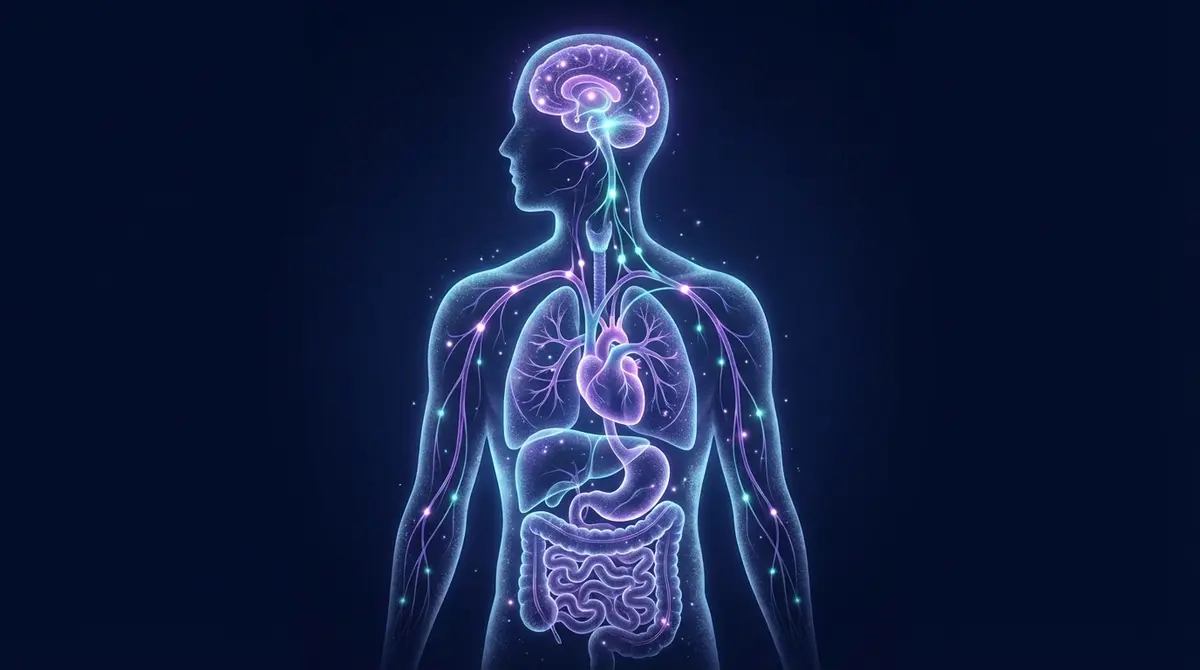
The Nerve That Connects Your Brain to Almost Everything
The vagus nerve is the tenth cranial nerve, and it is unlike any other nerve in your body. It runs from your brainstem down through your neck, chest, and abdomen, branching into your heart, lungs, digestive tract, and nearly every major organ. Its name comes from the Latin word for "wanderer," and it earned that name. No other nerve travels so far or touches so many systems.
What makes the vagus nerve relevant to sleep is its role as the primary communication highway of your parasympathetic nervous system. This is the branch of your autonomic nervous system responsible for rest, digestion, and recovery. When your vagus nerve is active and healthy (a state researchers call "high vagal tone"), your body can shift efficiently from stress states into recovery states. When vagal tone is low, that transition becomes difficult, and sleep is often the first casualty.
Stephen Porges, the neuroscientist who developed polyvagal theory, has spent decades mapping how vagal function shapes our ability to feel safe and regulated. His research demonstrates that the vagus nerve does not simply control heart rate. It integrates information from your body and your environment to determine whether conditions are safe enough for rest. Poor sleep, in many cases, is not a sleep problem at all. It is a safety problem, mediated by a nerve most people have never heard of.
Vagal Tone: What It Is and Why It Matters
Vagal tone refers to the activity level of your vagus nerve, and it is measurable. The primary metric is heart rate variability (HRV), the variation in time between consecutive heartbeats. Higher HRV indicates higher vagal tone, meaning your parasympathetic system is more active and your body is better equipped to adapt to stress and recover from it.
Research published in Psychophysiology has consistently linked low vagal tone to insomnia, anxiety, depression, and chronic inflammation. A 2018 study in Frontiers in Neuroscience found that individuals with higher resting vagal tone fell asleep faster, spent more time in deep sleep stages, and reported better subjective sleep quality than those with lower vagal tone.
The relationship is bidirectional. Poor sleep reduces vagal tone, and low vagal tone disrupts sleep. This creates a feedback loop that explains why sleep problems often feel self-perpetuating. Breaking this loop requires directly addressing vagal function, not just sleep hygiene.
How the Vagus Nerve Controls Your Sleep Architecture
Sleep is not a uniform state. It cycles through distinct stages: light sleep (N1, N2), deep slow-wave sleep (N3), and REM sleep. Each stage serves different functions, from memory consolidation to cellular repair to emotional processing.
The vagus nerve influences transitions between these stages in several ways:
Heart rate regulation. As you fall asleep, your heart rate needs to decrease. The vagus nerve is responsible for this deceleration through its direct innervation of the sinoatrial node. Research from the Journal of Sleep Research shows that impaired vagal cardiac control is associated with prolonged sleep onset latency and increased nighttime awakenings.
Respiratory sinus arrhythmia. In healthy sleep, your heart rate naturally rises slightly during inhalation and falls during exhalation. This pattern, called respiratory sinus arrhythmia (RSA), is mediated entirely by the vagus nerve and serves as a marker of parasympathetic dominance. Low RSA during sleep predicts fragmented, non-restorative sleep.
Inflammatory regulation. The vagus nerve controls the cholinergic anti-inflammatory pathway, which modulates immune system activity. When vagal tone is low, inflammatory markers like IL-6 and TNF-alpha rise. These pro-inflammatory cytokines directly disrupt sleep architecture, particularly reducing time spent in slow-wave sleep. A study in Brain, Behavior, and Immunity demonstrated that experimentally increasing vagal activity reduced circulating inflammatory markers and improved sleep depth.
Gut-brain signaling. Approximately 80% of vagal fibers are afferent, meaning they carry information from the body to the brain. A significant portion of these fibers originate in the gut. The gut microbiome produces neurotransmitters including GABA and serotonin (a precursor to melatonin), and these signals travel to the brain via the vagus nerve. Disrupted vagal gut-brain communication has been linked to both sleep disturbances and mood disorders.
Six Evidence-Based Ways to Stimulate Your Vagus Nerve
1. Slow, Deep Breathing
This is the most accessible and well-researched vagal stimulation technique available. When you exhale slowly, the resulting changes in thoracic pressure activate vagal afferents in the lungs and heart, triggering a parasympathetic response.
The key is making your exhale longer than your inhale. A 2017 study in Frontiers in Psychology found that breathing at approximately 6 breaths per minute (5 seconds in, 5 seconds out) maximized HRV and vagal tone. Even more effective was a 4-7-8 pattern (4 seconds inhale, 7 seconds hold, 8 seconds exhale), which Andrew Weil popularized based on pranayama breathing traditions.
Ten minutes of slow breathing before bed can measurably shift your nervous system state. It is not a relaxation trick. It is a direct physiological intervention targeting the nerve that controls your ability to rest.
2. Cold Exposure
Brief cold exposure activates the vagus nerve through thermoreceptors in the skin and triggers a parasympathetic rebound after the initial sympathetic spike. Research published in PLOS ONE found that regular cold water immersion increased vagal tone over a 6-week period.
You do not need ice baths. Splashing cold water on your face activates the mammalian dive reflex, a vagally-mediated response that slows heart rate and redirects blood flow to vital organs. Even 30 seconds of cold water on your face and neck can activate this pathway. For sleep purposes, doing this 2 to 3 hours before bed (not immediately before) allows the sympathetic activation to resolve while the vagal tone benefits persist.
3. Humming, Chanting, and Gargling
The vagus nerve innervates the muscles of the throat and larynx. Activating these muscles through humming, chanting, singing, or even gargling stimulates vagal afferents and increases parasympathetic activity.
A study in the International Journal of Yoga found that participants who practiced "Om" chanting showed significant increases in vagal tone compared to a control group. The vibration frequency generated during humming (approximately 130 Hz) appears to be particularly effective at stimulating vagal pathways in the throat.
This is one reason why listening to certain sound frequencies may support the transition to sleep. The vibrations interact with the same neural pathways that humming activates. At Healing Waves, our sleep tracks incorporate frequency patterns that were designed with this principle in mind: creating a sonic environment that supports parasympathetic activation rather than just masking silence.
4. Meditation and Mindfulness
Meditation practices that focus on interoception (awareness of internal body states) have been shown to increase vagal tone over time. A meta-analysis published in Clinical Psychology Review found that mindfulness meditation significantly increased HRV across 14 randomized controlled trials.
Loving-kindness meditation appears particularly effective. A study by Bethany Kok and Barbara Fredrickson, published in Psychological Science, found that a loving-kindness meditation practice increased vagal tone over a 9-week period, and that this increase predicted improvements in well-being and social connection.
For sleep specifically, body scan meditations that progressively direct attention through different body regions activate interoceptive vagal pathways and promote the parasympathetic state needed for sleep onset. Guided meditations that incorporate slow breathing cues amplify this effect.
5. Gut Health Support
Given that 80% of vagal fibers are afferent and many originate in the gut, supporting gut health directly influences vagal function. Probiotic supplementation, particularly strains like Lactobacillus rhamnosus, has been shown in animal studies to increase GABA receptor expression in the brain via vagal signaling. When researchers severed the vagus nerve in these studies, the benefits disappeared entirely.
Practical approaches include consuming fermented foods (yogurt, kimchi, sauerkraut), prebiotic fiber (garlic, onions, asparagus), and avoiding foods that trigger individual inflammatory responses. The relationship between meal timing and circadian rhythm adds another dimension: eating during appropriate circadian windows supports both gut function and vagal signaling.
6. Social Connection
Porges' polyvagal theory emphasizes that the newest branch of the vagus nerve (the ventral vagal complex) evolved specifically for social engagement. Eye contact, warm vocal tones, facial expressions of safety, and physical touch all activate this system.
This has practical implications for sleep. Research shows that people who report stronger social bonds have higher vagal tone and better sleep quality. A 2021 study in Psychosomatic Medicine found that perceived social support predicted both HRV and sleep efficiency over a 12-month period.
Isolation and loneliness, conversely, suppress vagal tone and disrupt sleep. If you live alone, even a brief phone call with someone you trust can shift your vagal state in the hours before bed.
Building a Vagal Toning Practice for Sleep
The most effective approach combines multiple strategies into a consistent evening routine:
- 3 hours before bed: Last meal of the day. Consider probiotic-rich foods.
- 2 hours before bed: Brief cold water on face and neck (30 seconds).
- 1 hour before bed: Dim lights, reduce stimulation.
- 30 minutes before bed: 5 minutes of humming or gentle singing.
- In bed: 10 minutes of slow breathing (4-7-8 pattern or 6 breaths/minute).
- Throughout the night: A sound environment that supports parasympathetic tone.
Consistency matters more than intensity. Vagal tone is trainable, like a muscle. The HeartMath Institute has documented that regular HRV biofeedback training can produce lasting increases in baseline vagal tone within 6 to 8 weeks of daily practice.
When Sleep Is a Nervous System Problem
If you have tried sleep hygiene strategies, optimized your bedroom environment, reduced caffeine, and still struggle to fall or stay asleep, the problem may not be behavioral. It may be neurological, specifically a vagus nerve that is not signaling safety to your brain.
This is not a character flaw or a lack of discipline. It is a physiological state that responds to specific interventions. The research on vagal stimulation for sleep is growing rapidly, and the early results are consistently positive.
Your nervous system is not broken. It may simply need a different kind of signal. One that tells it, clearly and consistently, that it is safe to let go.
If you are looking for a structured starting point, our Nervous System Repair Manual covers the foundational practices for rebuilding vagal tone and restoring your body's capacity for deep rest.
Start Sleeping Better Tonight
Join 14,500+ people who've transformed their sleep with healing frequencies, delta wave entrainment, and our progressive 21-night program.