Sleep Meditation: How to Rewire Your Brain for Effortless Rest
Sleep meditation isn't about forcing your mind to be quiet. It's about training your nervous system to recognize safety. Learn the neuroscience and practice that actually works.
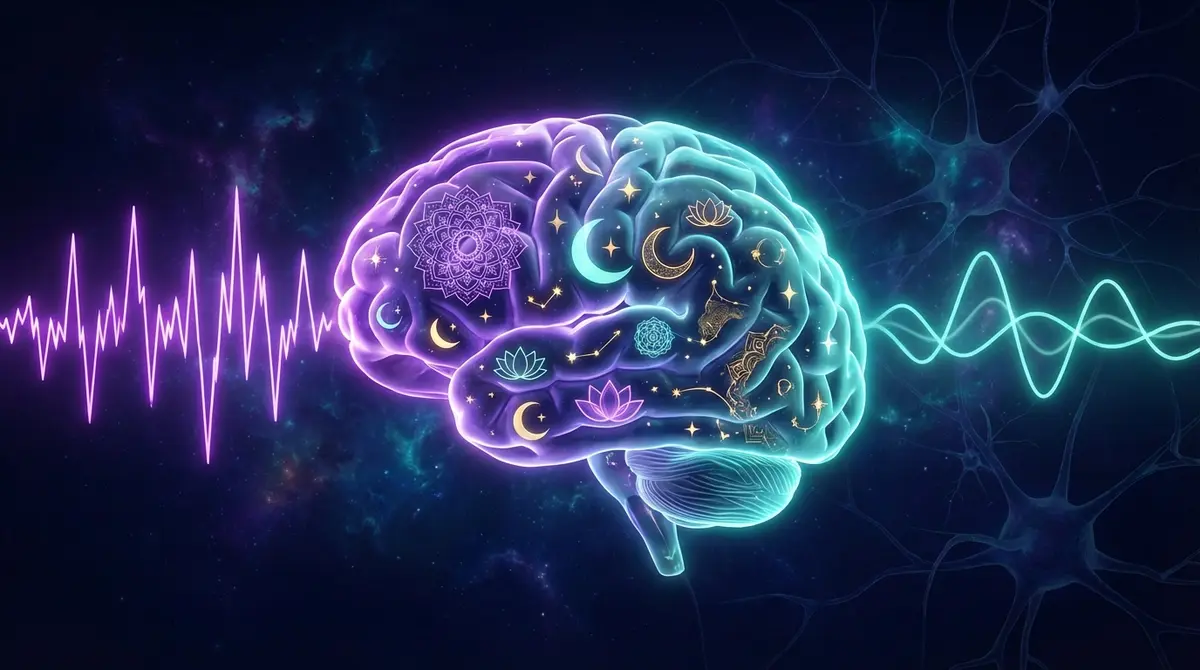
If you've ever been told to "just meditate" before bed and found yourself lying awake, more frustrated than before, you're not alone. Most people approach sleep meditation the wrong way—they think it's about forcing their mind to be quiet, about achieving some perfect state of stillness.
It's not. Sleep meditation is about training your nervous system to recognize safety. And once you understand that, everything changes.
Why Your Mind Won't "Turn Off"
Your brain isn't designed to have an off switch. Even in deep sleep, neural activity continues. The goal isn't to shut your mind down—it's to shift your nervous system from threat-detection mode into rest-and-digest mode.
Dr. Matthew Walker, director of UC Berkeley's Sleep and Neuroimaging Lab, explains that sleep is a neurological state transition. Your brain operates on distinct frequency bands: beta waves when you're alert (14–30Hz), alpha when you're relaxed (8–13Hz), theta as you drift toward sleep (4–8Hz), and delta during deep sleep (0.5–4Hz).
The problem most people face isn't that they can't sleep—it's that their nervous system is stuck in beta. Even when they're physically exhausted, their brain is scanning for threats. This is a survival mechanism gone haywire. Your amygdala (the fear center of your brain) doesn't know the difference between a predator and an unread email. It just knows: threat detected, stay alert.
Sleep meditation doesn't fight this pattern. It retrains it.
The Neuroscience of Sleep Meditation
When you meditate, you're not "clearing your mind." You're redirecting your attention. And this redirection has measurable neurological effects.
Functional MRI studies show that regular meditators have:
- Increased activity in the prefrontal cortex (the executive control center)
- Decreased activity in the amygdala (the fear and stress center)
- Enhanced connectivity between the prefrontal cortex and the insula (the part of the brain that processes bodily sensations)
Translation: meditation strengthens your ability to regulate your nervous system and weakens the automatic stress response. Over time, this rewiring becomes your default. You don't have to "try" to relax. Your brain has learned a new pattern.
A 2015 study published in JAMA Internal Medicine found that mindfulness meditation significantly improved sleep quality in adults with moderate sleep disturbances. Participants fell asleep faster, stayed asleep longer, and reported less daytime fatigue. The mechanism? Meditation activates the parasympathetic nervous system (rest-and-digest) while down-regulating the sympathetic nervous system (fight-or-flight).
But here's the key insight: meditation isn't about tonight's sleep. It's about reprogramming your nervous system for all the nights to come.
The Three Pillars of Effective Sleep Meditation
After analyzing clinical sleep studies and neuroscience research, three core elements emerge in meditation practices that consistently improve sleep outcomes.
1. Somatic Awareness (Body-Centered Focus)
Your mind might be racing, but your body is always in the present moment. When you shift your attention from thought to sensation, you anchor yourself in the here and now—and that's where the nervous system can finally relax.
Body scan meditation, developed by Jon Kabat-Zinn at the University of Massachusetts Medical School, is one of the most researched mindfulness practices. Studies show it reduces cortisol (your stress hormone), lowers heart rate, and increases heart rate variability (a marker of parasympathetic activation).
The practice is simple: systematically bring your attention to each part of your body, starting with your toes and moving up to your head. You're not trying to change anything—just notice. Tension in your shoulders? Notice it. Tingling in your feet? Notice it. A complete absence of sensation? Notice that too.
This act of non-judgmental observation sends a signal to your nervous system: I'm paying attention. I'm safe. There's no threat here. And when your nervous system receives that signal repeatedly, it begins to believe it.
2. Breath Regulation (Autonomic Entrainment)
Your breath is the only part of your autonomic nervous system you can consciously control. Change your breath, and you change your nervous system state.
Dr. Andrew Huberman, a neuroscientist at Stanford, explains that slow, deep breathing—especially when the exhale is longer than the inhale—activates the vagus nerve. This is the primary pathway of the parasympathetic nervous system, and activating it triggers what Dr. Herbert Benson at Harvard called the "relaxation response."
Effective sleep meditations incorporate breath patterns like:
- 4-7-8 breathing: Inhale for 4 counts, hold for 7, exhale for 8. This pattern maximizes vagal activation.
- Box breathing: Inhale 4, hold 4, exhale 4, hold 4. This creates nervous system coherence.
- Extended exhale: Inhale for 4, exhale for 6 or 8. This directly stimulates the parasympathetic response.
These aren't arbitrary numbers. They're designed to shift your nervous system out of fight-or-flight and into rest.
3. Cognitive Redirection (Mental Imagery)
Your brain doesn't distinguish well between imagined and real experiences. When you vividly visualize a peaceful environment, your brain activates the same neural circuits it would if you were actually there.
This is why guided visualizations are so effective for sleep. They give your mind something to focus on that's inherently calming, which prevents it from defaulting to worry or rumination.
The most effective sleep visualizations engage all five senses: not just what you see, but what you hear, feel, smell, and even taste in your imagined scene. The richer the sensory detail, the more fully your brain engages—and the less bandwidth it has for anxious thought.
Dr. Joe Dispenza, a researcher in neuroscience and behavior change, calls this "mental rehearsal." When you repeatedly imagine a state of deep rest, your brain begins to encode that state as a familiar pattern. Over time, it becomes easier to access—not just in meditation, but in sleep itself.
A Simple Sleep Meditation You Can Use Tonight
Here's a framework you can follow on your own or with a recorded guide. This protocol combines the three pillars we've covered.
Step 1: Settle Your Body (2 minutes)
Lie down in bed. Close your eyes. Take three slow, deep breaths—inhale through your nose, exhale through your mouth. With each exhale, let your body sink a little deeper into the mattress.
Notice the points of contact: your head on the pillow, your shoulders, your back, your legs. You're not trying to relax. You're just noticing what's already here.
Step 2: Body Scan (8 minutes)
Bring your attention to your toes. Notice any sensation—warmth, tingling, pressure, or nothing at all. Breathe into that area for three breaths, then move up to your feet, ankles, calves, knees, thighs, hips, belly, chest, shoulders, arms, hands, neck, face, and crown of your head.
If your mind wanders (and it will), gently guide it back to the body part you're focusing on. No judgment. Just return. Every time you return, you're strengthening your ability to redirect attention. That's the practice.
Step 3: Breath Awareness (5 minutes)
Now let your attention rest on your breath. Don't control it—just observe. Notice the cool air entering your nostrils, the slight pause at the top of the inhale, the warm air leaving on the exhale, and the stillness before the next breath begins.
If it feels natural, extend your exhales. Inhale for 4 counts, exhale for 6 or 8. Let the rhythm be effortless. You're not forcing anything. You're allowing your body to find its own pace toward rest.
Step 4: Visualization (10 minutes)
Imagine yourself in a place of complete safety and peace. Maybe it's a quiet forest at dusk, a warm room with soft light, or floating on calm water under stars.
Build the scene with sensory detail. What do you see? What sounds are present—rustling leaves, distant waves, gentle silence? What does the air feel like? Is there a scent?
Let yourself be there. Fully. Your body is here in bed, safe and still. Your mind is there, in that peaceful place. There's nothing to solve. Nothing to fix. Just this moment.
Step 5: Release (Until Sleep)
Now let go of everything. The visualization, the body scan, the breath control. You've done the work. Your nervous system has received the signal. Now you simply allow.
If thoughts arise, let them. They're just thoughts. They'll pass. You don't need to engage. Your body knows what to do. Sleep isn't something you force. It's something you surrender to.
Common Obstacles (And How to Work With Them)
"My Mind Won't Stop Racing"
That's not a failure. That's your brain doing what brains do. Meditation isn't about stopping thoughts—it's about changing your relationship with them.
When a thought arises, notice it. Label it ("thinking" or "planning" or "worrying"). Then gently return to your breath or body. Every time you return, you're training your brain to let go. That's the skill you're building.
"I Fall Asleep Too Quickly (Or Not at All)"
Both are fine. If you fall asleep during the meditation, that means your brain has associated the practice with the transition to sleep. Over time, this association will strengthen.
If you don't fall asleep, that's okay too. The goal isn't to force sleep—it's to shift your nervous system into a restful state. Sometimes sleep follows immediately. Sometimes it takes longer. Either way, you're building the neurological foundation for better sleep.
"I Don't Have Time for a Long Meditation"
Start with 5 minutes. Even a short body scan before bed can shift your nervous system. The length matters less than the consistency. A 5-minute practice every night will rewire your brain faster than a 30-minute practice once a week.
The Long-Term Rewiring Effect
Sleep meditation isn't a quick fix. It's a reprogramming tool. The first few nights, you're learning the process. By week two, your brain starts to recognize the pattern. By week four, the neurological pathways strengthen.
Within three months, studies show that regular meditators experience measurable changes in brain structure: increased gray matter in the hippocampus (memory and emotional regulation) and decreased gray matter in the amygdala (fear and stress response).
Harvard's Dr. Sara Lazar used MRI scans to demonstrate that just eight weeks of mindfulness meditation increases cortical thickness in areas associated with attention and emotional regulation. You're not just "coping better." Your brain is physically changing.
Beyond Sleep: The Ripple Effect
When you improve your sleep, everything improves. You think more clearly. You regulate emotions better. You make better decisions. You're less reactive to stress.
Dr. Matthew Walker's research shows that poor sleep impairs the prefrontal cortex—the part of your brain responsible for impulse control and emotional regulation. When you're sleep-deprived, you're operating with a compromised system. Meditation restores that system by addressing the root cause: a nervous system stuck in survival mode.
Your Next Step
Tonight, before bed, follow the protocol above. Don't expect perfection. Don't judge the outcome. Just practice. Your brain is listening. And over time, it will learn.
If you want guided support, explore our 21 Nights to Deep Sleep program—a structured journey combining sleep meditations, healing frequencies, and nervous system protocols designed to rewire your relationship with rest.
Or start free: download our Sleep Better Tonight guide for a science-backed protocol you can use immediately.
Your body already knows how to sleep. Meditation just reminds it how.
Start Sleeping Better Tonight
Join 14,500+ people who've transformed their sleep with healing frequencies, delta wave entrainment, and our progressive 21-night program.