The 3AM Wake-Up: Why It Happens and What to Do
Understand why you wake up at 3AM and can't fall back asleep. Learn the neuroscience behind middle-of-the-night awakenings and 5 techniques to get back to sleep fast.
# The 3AM Wake-Up: Why It Happens and What to Do
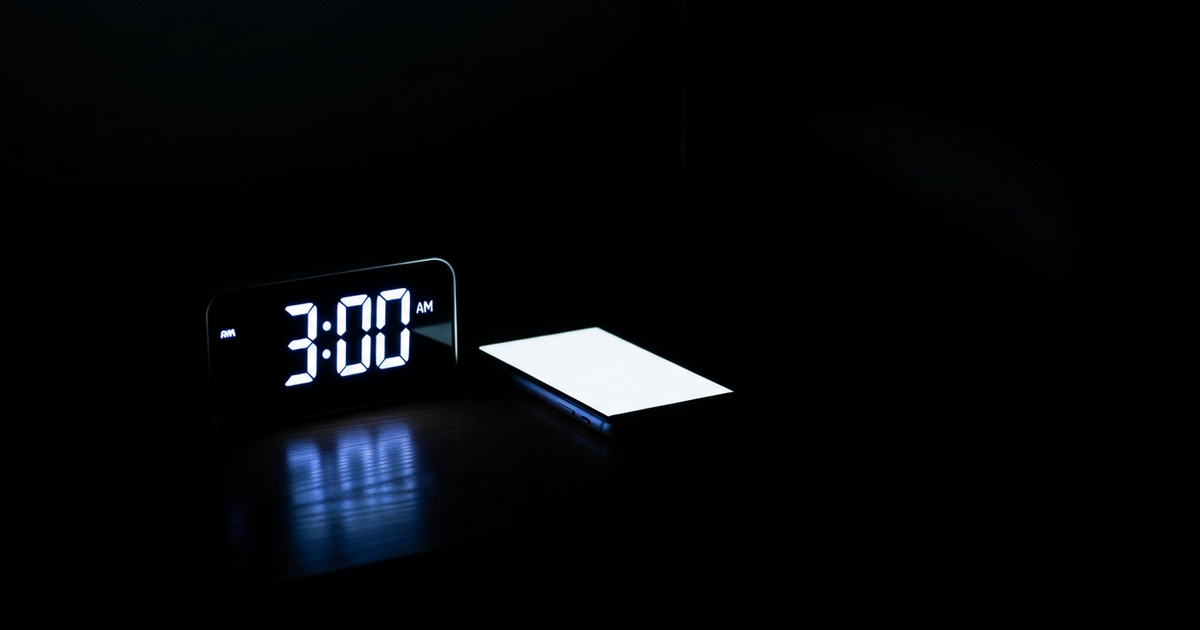
Your eyes open. You don't know why. The room is dark. You reach for your phone to check the time — and there it is. 3:17 AM.
A wave of frustration hits immediately. "Not again." Then the anxiety: "I have to be up in 3 hours." Then the math: "If I fall asleep right now, I can still get..." And now you're wide awake. The whole thing took about 12 seconds.
The 3 AM wake-up is one of the most common and distressing patterns in sleep anxiety. It's so consistent — almost always between 2 AM and 4 AM — that it can feel like something is genuinely wrong with you.
It's not. Your brain is doing something predictable, and once you understand why, you can stop the 12-second anxiety escalation that turns a normal wake-up into hours of lost sleep.
Why 3 AM? The Neuroscience
The timing isn't random. Several biological processes converge around 3 AM:
The Cortisol Rise Begins
Cortisol — your primary stress hormone — follows a predictable daily cycle. It bottoms out around midnight-1 AM, then begins a gradual rise starting around 2-3 AM, building toward its peak at wake-up time (the cortisol awakening response).
In someone with normal cortisol regulation, this rise is too gentle to cause arousal. But in someone with elevated baseline stress or nervous system dysregulation, the early cortisol rise can cross the arousal threshold — just enough to trigger a micro-awakening.
You're in REM Territory
Sleep architecture shifts through the night. Your first sleep cycles (hours 1-4) are deep-sleep dominant — lots of delta wave activity, very hard to wake from. But later cycles (hours 4-8) become REM-dominant.
Around 3 AM, you're likely transitioning into or out of a REM cycle. REM sleep involves increased brain activity, emotional processing, and sympathetic nervous system activation. The transition between REM and lighter sleep stages is a natural vulnerability window for waking.
Core Body Temperature Dip
Your core body temperature reaches its lowest point around 3-4 AM. While cooling promotes sleep onset, the nadir itself can trigger a brief arousal as your body's thermoregulation systems activate to prevent excessive cooling.
Blood Sugar Dynamics
If you ate a high-carbohydrate dinner or consumed alcohol, blood sugar levels may drop into the hypoglycemic range by 3 AM. This triggers a counter-regulatory hormonal response — adrenaline and cortisol are released to raise blood sugar — which produces physical arousal (racing heart, sweating, alertness).
Why You Can't Fall Back Asleep
Waking briefly at 3 AM is actually normal — everyone experiences brief arousals between sleep cycles. Good sleepers simply don't remember them. The problem isn't the waking. It's what happens next.
The Clock Check
The single most damaging behavior: checking the time. The moment you see "3:17 AM," your brain performs instant arithmetic (how many hours left, how bad tomorrow will be). This math generates anxiety, which generates cortisol, which generates alertness. You've just converted a 30-second arousal into a full wake-up.
The Silence Problem
If you fell asleep without sound, you wake into silence — and silence at 3 AM is not neutral. Your threat-detection circuits interpret nighttime silence differently from daytime silence. The absence of "safe" sounds (human voices, household activity, nature) can subtly elevate vigilance.
The Thought Avalanche
With the prefrontal cortex still partially offline from sleep, your emotional brain (amygdala) has disproportionate influence. Worries that would be manageable at 3 PM feel catastrophic at 3 AM. This is why anxiety worsens at night — the rational moderator is asleep while the alarm system is wide awake.
What to Do When You Wake at 3 AM
Rule 1: Don't Check the Time
This is the single most impactful change you can make. Turn your clock away from the bed. Put your phone face-down or in another room. The time is irrelevant — knowing it only hurts. Whatever time it is, the best thing you can do is the same: rest quietly and let sleep return.
Rule 2: Don't Open Your Eyes
Darkness tells your brain "it's still nighttime." Light — even the dim glow of a phone screen — signals "waking time" and suppresses melatonin. Keep your eyes closed. If they're already open, close them immediately.
Rule 3: Use the Physiological Sigh
Without changing position, without opening your eyes, perform 3-5 physiological sighs: double inhale through the nose → long exhale through the mouth. This takes 30-50 seconds and directly activates the vagus nerve, counteracting the cortisol-driven arousal that woke you.
Rule 4: Have Sound Already Playing
This is why 8-hour sleep tracks outperform 30-minute fall-asleep tracks. If a delta frequency track is still playing when you wake at 3 AM, you have immediate auditory support:
- The sound provides a non-threatening auditory environment (countering the silence problem)
- The delta frequencies support the transition back into deeper sleep stages
- The familiar sound acts as a conditioned sleep cue ("this sound means sleep")
- Your attention has somewhere to go that isn't your anxious thoughts
Rule 5: Give Yourself Permission
"If I fall back asleep, great. If I don't, I'll rest and be fine." This isn't positive thinking — it's removing the performance pressure that turns a wake-up into a crisis. The paradox of sleep anxiety applies here too: the less you care about falling back asleep, the faster it happens.
Rule 6: The 20-Minute Rule
If you're still fully awake after 20 minutes (estimated — don't check the clock), get up. Go to another room. Read something boring in dim light. Avoid screens entirely. Return to bed only when you feel genuinely drowsy.
This stimulus control technique prevents the bed from becoming associated with 3 AM frustration. It feels counterintuitive — getting up when you want to sleep. But it's one of the most evidence-supported interventions in CBT-I.
Prevention: Reducing 3 AM Wake-Up Frequency
While you can't eliminate all middle-of-the-night awakenings (they're a normal part of sleep architecture), you can reduce their frequency and prevent them from escalating:
Evening nutrition: Avoid high-carbohydrate meals within 2 hours of bed. If you tend to wake with racing heart or sweating, try a small protein-rich snack before bed (a handful of almonds, a small piece of cheese) to stabilize overnight blood sugar.
Alcohol reduction: Alcohol is one of the strongest predictors of 3 AM awakenings. It suppresses deep sleep, disrupts REM architecture, and causes rebound sympathetic activation as it metabolizes (typically 3-5 hours after consumption). Even one drink measurably affects sleep architecture.
All-night sound support: Start your sleep track at bedtime and let it run through the night. The continuous brainwave entrainment and masking reduce both the frequency of awakenings and the escalation of those that do occur.
[Nervous system regulation](/blog/nervous-system-reset-for-sleep) before bed: The lower your sympathetic activation at sleep onset, the less likely the cortisol rise at 3 AM will cross your arousal threshold. Pre-sleep vagal activation effectively raises the bar that needs to be cleared for a wake-up to occur.
Bedroom temperature: 18-20°C (65-68°F). A room that's too warm or too cold creates thermal arousals throughout the night.
It's Normal. It's Manageable. It's Not Forever.
Waking in the middle of the night is something your brain has done every night of your life — you just don't usually remember it. The 3 AM wake-up becomes a problem only when it escalates into extended wakefulness, and that escalation is driven by anxiety, not by the waking itself.
Don't check the time. Keep your eyes closed. Breathe. Let the sound carry you back.
---
This is part of our guide on [Sleep Anxiety](/blog/sleep-anxiety). See also: [How Sound Healing Works for Sleep](/blog/sound-healing-for-sleep) and [Your Nervous System and Sleep](/blog/nervous-system-reset-for-sleep).
Start Sleeping Better Tonight
Join 14,500+ people who've transformed their sleep with healing frequencies, delta wave entrainment, and our progressive 21-night program.