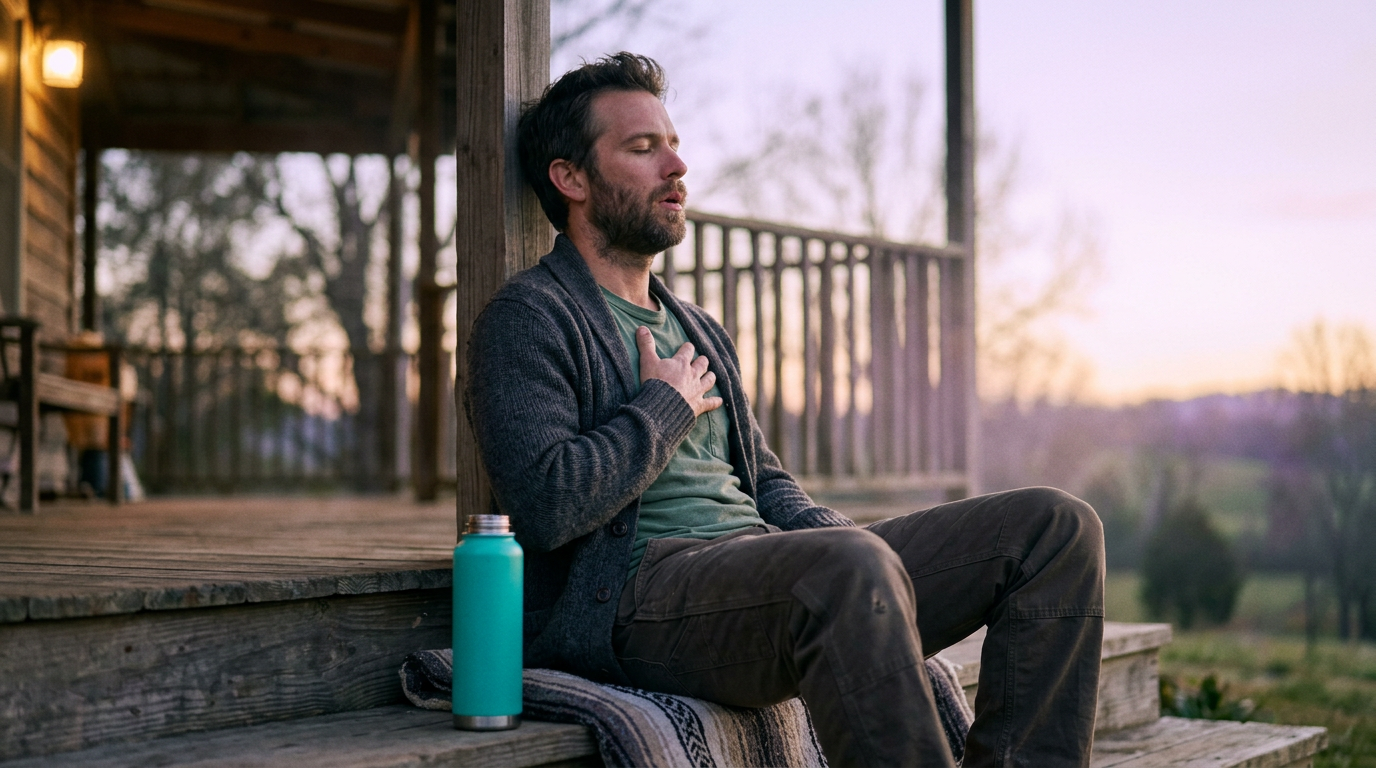
The email lands, your chest tightens, and the next meeting starts in ninety seconds. For exactly this kind of moment there is a tool your body already knows: the physiological sigh, a double inhale followed by a long slow exhale that downshifts your nervous system in under a minute. Babies do it mid cry, sleepers do it all night, and you have done it after every good cry of your life. This guide teaches the technique properly, explains why it works, walks through the honest research behind it, and adds a small kit of other sixty second resets for the moments that arrive before your calendar has an opening.
What is the physiological sigh?
The physiological sigh is a breathing pattern with two inhales and one long exhale: a deep breath in through the nose, a second short top up inhale on top of it, then a slow, complete exhale through the mouth. One to four repetitions is a full dose, and the whole reset fits inside a minute.
Your body invented it. Spontaneous sighs of exactly this shape punctuate sleep and show up whenever breathing becomes shallow for too long, the respiratory system's own maintenance routine. The deliberate version simply borrows the reflex on demand, which is part of why it needs no practice period, no app, and no privacy: done quietly through the nose, it is invisible in a meeting.
One more everyday proof before the instructions: think of how a child's breathing changes at the end of a long cry, two ragged inhales, one shuddering exhale, and then calm arrives. That is the pattern working exactly as designed, unprompted, in the most dysregulated humans on earth. The deliberate version simply schedules it.
How do you do it correctly?
Sit or stand comfortably. Inhale deeply through the nose until the lungs feel full, then sip one more short inhale on top. Let the exhale leave slowly through the mouth, longer than both inhales combined, until the lungs feel genuinely empty. Repeat one to three more times if the moment needs it.
The two details that matter: the second inhale is small and quick, a top up that pops open the parts of the lungs that shallow breathing collapses, and the exhale is unhurried, the slower the better. Shoulders stay soft, jaw unclenches on the way out. If you feel lightheaded, pause and breathe normally; the technique should feel like relief, never like effort. People with respiratory or cardiac conditions, and anyone for whom breath focus stirs panic, should meet this practice gently and bring their clinician into the conversation.
Discretion is a real feature, worth naming. Done through the nose with a gentle mouth exhale, the whole reset reads as ordinary breathing to everyone else in the room, which means the tool is available in the exact meetings, dinners, and hospital corridors where visible coping tools are least welcome.
Why does it work so fast?
The double inhale reinflates tiny air sacs that collapse during stressed, shallow breathing, letting the lungs offload carbon dioxide efficiently on the long exhale. That slow exhale also activates the calming half of your nervous system, easing heart rate down within seconds. Mechanics first, then physiology of calm.
The exhale is the lever with the pedigree: extending it engages the parasympathetic brake that Harvard Health Publishing describes as the body's recovery system, the counterweight to the stress accelerator. Heart rate rises slightly on every inhale and falls on every exhale, so a breath shaped mostly of exhale tilts the whole rhythm toward settling. Stack the improved gas exchange on top and you get the rare intervention that works through plumbing and wiring at the same time, which is why the effect arrives in seconds instead of sessions.
What does the research actually show?
In a 2023 randomized study from Stanford, five minutes of daily cyclic sighing for 28 days improved mood more than mindfulness meditation and lowered resting respiratory rate, the study's marker of reduced arousal. All four practices tested helped; the sighing pattern helped most, and its benefits grew with practice.
The study, Balban and colleagues in Cell Reports Medicine, compared cyclic sighing, box breathing, cyclic hyperventilation with retention, and mindfulness meditation, five minutes daily across a month. The authors' own conclusion is a model of measured language: daily five minute cyclic sighing "has promise as an effective stress management exercise." Promise is the honest word. The field is young and samples are modest, so the plain summary reads: one strong study leads a young literature, the mechanism is solid physiology, the cost is zero, and your own two week test settles the personal question better than any journal can.
When should you reach for it?
Before hard conversations, after jolting messages, between back to back meetings, at red lights on heavy days, in the corridor outside the appointment, and during 3am wakings when the mind starts drafting emails. Any moment where you notice the surge and want a working version of yourself back quickly.
The skill underneath is noticing, and anchors help: pair the sigh with recurring triggers, closing the laptop, the phone buzzing, standing up from your desk, and the reset starts running on rails. Used this way it becomes spike hygiene, the practice of ending stress responses on purpose, which our cortisol and nervous system guides place at the center of daily regulation. One honest boundary: the sigh resets a moment. It does no deeper repair, which is what sleep, movement, connection, and sometimes a professional are for.
Zoom out once before the toolkit grows. Mental longevity is the lifelong capacity to think clearly, regulate your inner state, adapt to change, keep learning, maintain meaningful connections, and live intentionally. The sigh is the smallest possible unit of the second item on that list, Regulation in sixty seconds, and small units are how the capability actually gets built: one noticed moment, one deliberate exhale, hundreds of times across a year.
What other sixty second resets earn a place?
Four more with real mechanisms: box breathing for steady focus under pressure, a long exhale count when double inhales feel awkward, gaze widening to counter stress tunnel vision, and the 5-4-3-2-1 senses check for spiraling thoughts. Cold water on the face adds a stronger jolt where appropriate.
Box breathing, four counts in, four held, four out, four held, suits performance moments where you want alert calm instead of sleepy calm. The simple long exhale, in for four, out for eight, delivers most of the sigh's benefit in any posture, mask, or meeting. Widening your gaze to take in the whole room counters the narrowing that arousal forces and pairs beautifully with either breath. The senses inventory, five things seen, four felt, three heard, two smelled, one tasted, gives a racing mind a concrete job. And cold water on the face triggers an ancient slow down reflex, best saved for moments with sink access and skipped by anyone with cardiac conditions unless their clinician agrees. Collect two or three that fit your actual days; a kit you remember beats a library you admire.
A four week arc for making it automatic: week one, use it only at one anchor, like closing the laptop. Week two, add the acute moments as they arrive. Week three, try the five minute practice version three mornings. Week four, notice what changed in your recovery speed and keep whichever dose earned it. By then the technique stops being a technique and becomes what your body simply does when a moment spikes, which was the reflex's job description all along.
Frequently asked questions
How many physiological sighs make a dose?
One to four repetitions handles an acute moment, and the Stanford protocol used five continuous minutes as daily practice. Both are legitimate: the short version as an in the moment reset, the five minute version as training that compounds across weeks. Start with the short version; graduate if you like the results.
Can it make me dizzy?
Brisk repeated breathing can, especially if the inhales get greedy. Lightheadedness is a signal to stop and breathe normally, never something to push through, and seated practice removes most of the risk. Keep the second inhale small, the pace unhurried, and involve a clinician if you have respiratory, cardiac, or panic related conditions.
Physiological sigh or box breathing, which is better?
In the Stanford comparison, cyclic sighing edged the others on mood and respiratory rate, and box breathing still performed well. Practically: sighing excels at rapid downshifts, box breathing at composed alertness before performance. Test both for two weeks and keep what your body votes for.
Is it safe while driving or with kids around?
The gentle one to four rep version is quiet, eyes open, and safe in ordinary situations, including behind the wheel at a stop. Extended breathwork sessions belong in a seat, never in traffic. Children often enjoy the technique; teaching it as blowing out slow birthday candles works remarkably well.
Small tools carry further in company. People in our community trade their favorite resets, their trigger anchors, and their honest reports of what a month of practice changed, which turns sixty second techniques into lasting habits. When you are ready, join us in the HumanOS Community. Bring your hardest moment of the week; someone there has its twin.