Sleep Anxiety: Breaking the Cycle of Worrying About Not Sleeping
Sleep anxiety creates a vicious cycle where fear of not sleeping keeps you awake. Learn how to recognize the pattern, apply CBT-i techniques, and finally break free from nighttime worry.
# Sleep Anxiety: Breaking the Cycle of Worrying About Not Sleeping
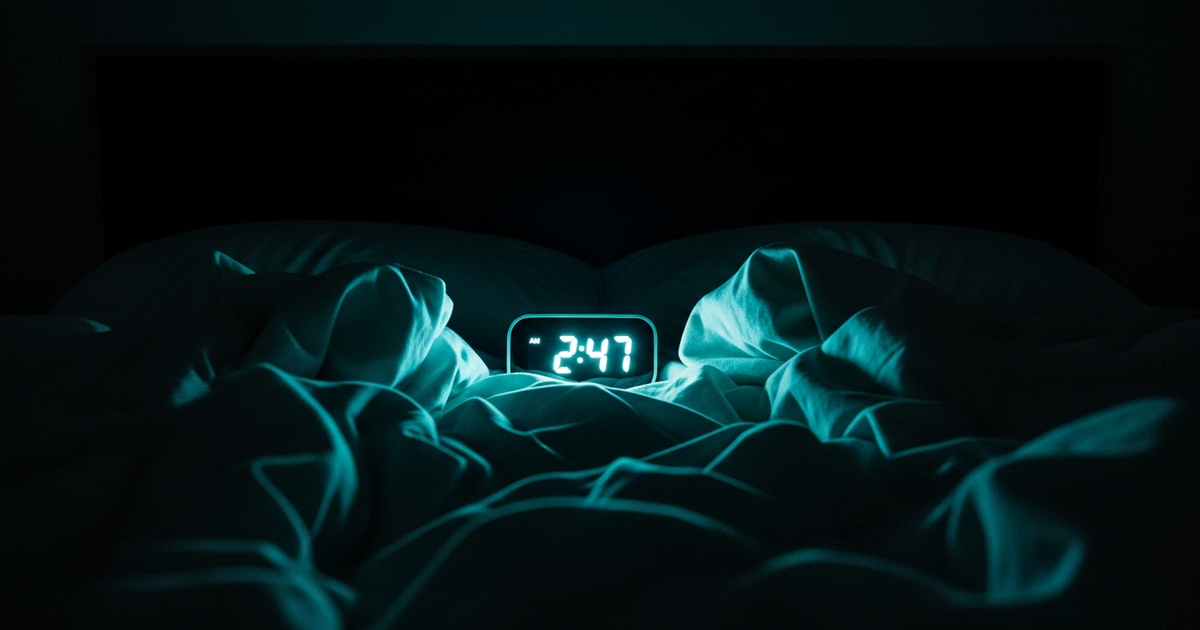
It's 11 PM. You've done everything right. The room is dark, your phone is off, you've had your herbal tea. And yet, as your head hits the pillow, a familiar thought creeps in: What if I can't sleep tonight?
That single thought changes everything. Your heart rate ticks up. Your muscles tense. You become hyper-aware of every sensation in your body, monitoring yourself for signs of sleepiness that stubbornly refuse to arrive. The clock becomes your enemy. Every minute that passes without sleep feeds the anxiety, and the anxiety feeds the wakefulness. Round and round it goes.
This is sleep anxiety, sometimes called somniphobia or sleep dread. It's one of the most common and frustrating forms of insomnia because the very act of wanting to sleep becomes the thing that prevents it. And if you've experienced it, you know how isolating and exhausting it can be.
But here's something important: sleep anxiety is not a life sentence. It's a learned pattern, and learned patterns can be unlearned. This article will help you understand exactly why this happens and give you concrete, evidence-based strategies to break the cycle.
Key Takeaways
- Sleep anxiety is a conditioned response where your brain has learned to associate bedtime with stress rather than rest
- The "effort" to sleep is the core problem. Sleep is a passive process that happens when you stop trying to make it happen
- CBT-i (Cognitive Behavioral Therapy for Insomnia) is the gold-standard treatment with a 70 to 80% success rate, higher than sleeping pills
- Cognitive restructuring helps you identify and challenge the catastrophic thoughts that fuel sleep anxiety
- Paradoxical intention and stimulus control are two powerful techniques that can begin working within days
- You are not broken. Sleep anxiety is extremely common and extremely treatable
Understanding the Sleep Anxiety Cycle
To break a cycle, you first need to see it clearly. Sleep anxiety follows a predictable pattern that feeds on itself.
The Anatomy of the Cycle
Step 1: A bad night. Everyone has them. Stress, illness, travel, a noisy neighbor. Something disrupts your sleep, and you have one or two rough nights. This is normal and not a problem on its own.
Step 2: Worry creeps in. After the bad night, you start thinking about sleep during the day. Will I sleep tonight? What if I don't? I can't afford another bad night. These thoughts plant the seeds of anxiety.
Step 3: Bedtime becomes threatening. Your brain, always looking for threats, begins to associate the bedroom (and specifically the act of trying to sleep) with danger. Cortisol and adrenaline rise right when they should be falling.
Step 4: Hyperarousal. In bed, your nervous system is in a state of heightened alertness. Your brain is literally in fight-or-flight mode. Sleep is biologically impossible in this state because your body thinks it needs to stay awake to survive.
Step 5: Sleep doesn't come. The anxiety was right! You can't sleep! This "confirms" the fear and strengthens the association between bedtime and danger.
Step 6: The cycle reinforces itself. Each sleepless night makes the next night's anxiety worse. Each anxious night makes sleep harder. Without intervention, this pattern can persist for months or even years.
Why Your Brain Does This
Your brain isn't malfunctioning. It's actually doing exactly what it evolved to do: protecting you from perceived threats. The problem is that it has incorrectly classified "trying to sleep" as a threat.
This is a form of classical conditioning, similar to Pavlov's dogs. After enough pairings of "bed" with "stressful wakefulness," your brain creates an automatic association. Just walking into the bedroom can trigger a stress response.
The amygdala (your brain's alarm system) doesn't distinguish between real danger and perceived danger. If it's learned that bedtime is stressful, it will activate the stress response every night, regardless of whether you're actually in any danger.
The Paradox at the Heart of Sleep Anxiety
Here's the central insight that changes everything: sleep is not something you do. It's something that happens to you when the conditions are right.
You cannot force sleep any more than you can force digestion or force your heart to beat. Sleep is an automatic biological process that occurs when your brain feels safe enough to disengage from conscious awareness.
This means that every effort you make to try harder to sleep actually moves you further from sleep. Trying harder increases mental engagement. Mental engagement increases arousal. Arousal prevents sleep. More failure to sleep increases anxiety. More anxiety increases effort. And the cycle continues.
The solution, counterintuitively, is to stop trying to sleep. This doesn't mean giving up or not caring. It means redirecting your effort from "making sleep happen" to "creating conditions where sleep can happen on its own."
Cognitive Behavioral Therapy for Insomnia (CBT-i)
CBT-i is the first-line treatment for chronic insomnia recommended by the American Academy of Sleep Medicine, the American College of Physicians, and the European Sleep Research Society. It's more effective than sleeping pills in the long term, with studies showing improvement in 70 to 80% of patients.
Unlike medication, which masks symptoms, CBT-i addresses the root causes of sleep anxiety. And unlike medication, the benefits persist long after treatment ends.
CBT-i has several components. Here are the ones most relevant to sleep anxiety.
Cognitive Restructuring: Changing How You Think About Sleep
The "cognitive" part of CBT-i involves identifying and challenging the thoughts that fuel your anxiety. Many people with sleep anxiety hold beliefs about sleep that are either inaccurate or exaggerated, and these beliefs create enormous pressure.
Common sleep anxiety thoughts and how to reframe them:
"If I don't sleep tonight, tomorrow will be a disaster."
Reframe: "I've had bad nights before and still functioned the next day. It wasn't pleasant, but I survived. One bad night doesn't ruin an entire day."
"I need 8 hours of sleep or my health will suffer."
Reframe: "Sleep needs vary from person to person. Many healthy adults function well on 6 to 7 hours. Quality matters more than quantity. My body will get the sleep it needs."
"I've been awake for 2 hours. The night is ruined."
Reframe: "People regularly overestimate how long they've been awake. Even if I'm awake now, I'll likely drift off eventually. Resting quietly also has value."
"Something is seriously wrong with me. Normal people don't have this problem."
Reframe: "One in three adults struggles with sleep. This is incredibly common. Sleep anxiety is a learned pattern, not a disorder. It can be unlearned."
"I'll never be able to sleep normally again."
Reframe: "Sleep anxiety responds well to treatment. Millions of people have overcome it. My brain is capable of sleeping. It's just stuck in a pattern."
How to Practice Cognitive Restructuring
Keep a thought journal by your bed (use a dim book light, not your phone). When anxious thoughts arise:
- Write down the exact thought. "I'll be exhausted tomorrow and mess up my presentation."
- Rate your belief in the thought on a scale of 0 to 100%.
- Examine the evidence. Is this thought based on fact or fear? Have you functioned after bad sleep before?
- Write a balanced alternative. "I might be tired, but I've performed well on little sleep before. Adrenaline will carry me through."
- Rate your belief in the new thought on a scale of 0 to 100%.
Over time, this process weakens the automatic anxious thoughts and builds new, more realistic neural pathways.
Stimulus Control: Retraining Your Brain's Bedroom Association
This technique was developed by sleep researcher Richard Bootzin and is one of the most effective components of CBT-i for sleep anxiety. The goal is to rebuild the association between your bed and sleep (rather than bed and anxiety).
The rules are simple:
- Use your bed only for sleep and intimacy. No reading, no TV, no scrolling, no worrying in bed. This is critical.
- Go to bed only when you feel sleepy. Not tired. Sleepy. There's a difference. Sleepy means your eyes are heavy and you're struggling to stay awake. Tired means you're fatigued but still mentally alert.
- If you can't sleep within about 15 to 20 minutes, get up. Go to another room and do something quiet and non-stimulating (reading a paper book, gentle stretching, listening to calming music). Return to bed only when you feel sleepy again.
- Repeat as many times as necessary. Some people get up three or four times the first few nights. That's okay. You're retraining your brain.
- Wake up at the same time every day, regardless of how much sleep you got. Yes, even on weekends. This is essential for resetting your circadian rhythm.
The first few nights of stimulus control can be rough. You might get less sleep than usual. But within one to two weeks, most people notice a dramatic improvement. Your brain begins to associate the bed with sleep again instead of with anxiety and wakefulness.
Paradoxical Intention: Trying to Stay Awake
This technique sounds counterintuitive, but it's backed by solid research. Instead of trying to fall asleep, try to stay awake. Lie in bed with your eyes open (in the dark) and gently resist the urge to sleep.
Don't use screens or do anything stimulating. Simply lie there and try to keep your eyes open. Don't force them open aggressively. Just gently resist closing them.
Why does this work?
It removes performance anxiety. When you're trying to stay awake, there's no pressure to fall asleep. No pressure means less anxiety. Less anxiety means less arousal. Less arousal means sleep comes naturally.
A meta-analysis published in Behavioural and Cognitive Psychotherapy found that paradoxical intention significantly reduced sleep onset latency and subjective sleep disturbance. Many patients reported that they fell asleep "accidentally" while trying to stay awake, sometimes on the very first night.
Sleep Restriction: Counterintuitive but Powerful
This is perhaps the most challenging CBT-i technique, but also one of the most effective. The idea is to temporarily limit your time in bed to match the amount of sleep you're actually getting.
For example, if you spend 8 hours in bed but only sleep 5 hours, you would restrict your time in bed to 5.5 hours. This creates mild sleep deprivation, which increases your sleep drive and reduces the time you spend lying awake. As your sleep efficiency improves, you gradually increase your time in bed.
Important: Sleep restriction should ideally be done under the guidance of a healthcare professional, as it can temporarily increase daytime sleepiness. It's not recommended for people with bipolar disorder, seizure disorders, or in occupations where alertness is safety-critical.
Practical Strategies for Tonight
While CBT-i is the most effective long-term approach, here are strategies you can start using tonight to begin loosening sleep anxiety's grip.
Create a Worry Window
Set aside 15 to 20 minutes in the early evening (not close to bedtime) for a dedicated "worry time." Sit down with a pen and paper and write down everything that's on your mind. Problems, fears, tomorrow's to-do list, unresolved issues. Get it all out.
When anxious thoughts arise at bedtime, remind yourself: "I've already dealt with this during my worry window. I can think about it again tomorrow during the next one."
The "So What" Ladder
When an anxious thought strikes at bedtime, follow it to its logical conclusion with compassion:
"I might not sleep tonight." So what?
"I'll be tired tomorrow." So what?
"I might not perform as well." So what?
"People might notice." So what?
"I'll get through the day and try again tomorrow night."
By following the chain to its end, you often find that the worst-case scenario is survivable. This defuses the urgency that anxiety creates.
Ground Yourself in the Present
Anxiety is always about the future. Sleep happens in the present. Use the 5-4-3-2-1 grounding technique:
- 5 things you can feel (the weight of the blanket, the pillow under your head, the mattress beneath you, the temperature of the air, the fabric against your skin)
- 4 things you can hear (your breathing, the hum of the room, distant traffic, the settling of the house)
- 3 slow, deep breaths
- 2 things you can smell
- 1 kind thing you can say to yourself ("I am safe. Sleep will come when it's ready.")
Use Calming Audio as an Anchor
Many people with sleep anxiety find that silence amplifies anxious thoughts. Having a gentle auditory anchor can give your mind something neutral to focus on instead of worrying.
Deep sleep music or healing frequency compositions can be particularly helpful because they provide consistent, soothing sound throughout the night. At Healing Waves, our 8-hour tracks are designed to be barely perceptible, creating a cocoon of sound that your mind can rest in without being stimulated.
Journaling Before Bed
Spend 5 minutes writing down three things that went well today and one thing you're looking forward to tomorrow. Research from the Journal of Experimental Psychology found that writing a to-do list for the next day before bed helped people fall asleep significantly faster than writing about completed activities. Getting tasks out of your head and onto paper reduces the cognitive load that keeps your brain spinning.
Lifestyle Factors That Reduce Sleep Anxiety
Exercise (But Timing Matters)
Regular physical activity is one of the most effective natural anxiety reducers. A meta-analysis of 49 studies found that exercise reduced anxiety symptoms by a magnitude comparable to medication. For sleep specifically, moderate aerobic exercise (like brisk walking, cycling, or swimming) performed at least 4 to 6 hours before bedtime is ideal.
Limit Caffeine and Alcohol
Caffeine has a half-life of 5 to 6 hours, meaning half the caffeine from your afternoon coffee is still in your system at bedtime. For people with sleep anxiety, even morning caffeine can be problematic because it keeps the nervous system more activated throughout the day. Consider reducing or eliminating caffeine for a few weeks to see if it helps.
Alcohol, while initially sedating, fragments sleep and increases nighttime awakenings. It can also increase anxiety during the second half of the night as your body metabolizes it.
Build a Transition Period
Don't go from full-speed daily activity straight to bed. Create a 30 to 60 minute wind-down period where you progressively reduce stimulation. Dim the lights, put away screens, and engage in calming activities. Think of it as slowly pulling off the highway rather than slamming on the brakes.
For more environmental and behavioral tips, check out our sleep hygiene checklist.
Practice Daytime Relaxation
The nervous system is like a muscle. If you only try to relax at bedtime, it's like trying to run a marathon without training. Practice relaxation techniques during the day, when the stakes are low. The 4-7-8 breathing technique is excellent for this. Use it during your commute, at your desk, or during lunch. The more you practice when you're not trying to sleep, the more effective it becomes at bedtime.
When Sleep Anxiety Is Part of a Bigger Picture
For some people, sleep anxiety exists alongside broader anxiety or depression. If you experience persistent worry that extends beyond sleep, panic attacks, overwhelming feelings of sadness or hopelessness, or difficulty functioning in daily life, please reach out to a mental health professional. Sleep anxiety can be both a symptom and a cause of broader mental health challenges, and addressing the underlying condition often resolves the sleep issues as well.
CBT-i can be done in person with a therapist, through structured online programs, or even through self-help books. If in-person therapy isn't accessible, the book Quiet Your Mind and Get to Sleep by Colleen Carney and Rachel Manber is an excellent CBT-i resource.
A Message of Hope
If you're reading this at 2 AM with your heart pounding and your mind racing, here's what I want you to know: this will pass.
Sleep anxiety feels permanent when you're in it. It feels like something is fundamentally broken. But it's not. Your brain is perfectly capable of sleeping. It's just stuck in a pattern of fear. And patterns can be changed.
Thousands of people have broken the sleep anxiety cycle using the techniques in this article. Many of them felt exactly the way you feel right now. Hopeless, exhausted, frustrated. And they came out the other side.
Be patient with yourself. Be compassionate. And remember: even tonight, even if sleep doesn't come quickly, you are safe. You will be okay.
Break Free from Sleep Anxiety
At Healing Waves, we created our 21 Nights to Deep Sleep program as a gentle, guided journey to help you rebuild your relationship with sleep. Over the course of 21 nights, you'll work through progressive relaxation, healing frequency sessions, and techniques inspired by CBT-i principles, all delivered through carefully crafted audio designed to help your nervous system remember how to let go.
If you'd like to start with something smaller, our free sleep tracks are a great way to give your anxious mind a calming anchor tonight. Many of our listeners with sleep anxiety tell us that having consistent, gentle audio throughout the night was the first step in breaking their cycle.
You deserve restful sleep. It's not a luxury. It's a birthright. And it's closer than you think.
Listen Now on Insight Timer
Free on Insight Timer — rated 4.8★ by thousands of listeners
Start Sleeping Better Tonight
Join 14,500+ people who've transformed their sleep with healing frequencies, delta wave entrainment, and our progressive 21-night program.