Sleep Anxiety: Why Your Mind Races at Night and How to Stop It
Understand sleep anxiety — why your mind races at bedtime, the hyperarousal cycle, and evidence-based techniques to break free from anxious insomnia.
# Sleep Anxiety: Why Your Mind Races at Night and How to Stop It
It starts the same way every night.
You brush your teeth. You get into bed. And somewhere between pulling up the covers and closing your eyes, a familiar dread settles in. Not dread about anything specific — dread about the night itself. About the hours of lying awake that you know are coming. About the exhaustion that tomorrow will bring.
This is sleep anxiety — the fear of not being able to sleep, which, paradoxically, becomes the very thing that prevents sleep.
It's not the same as general anxiety that happens to show up at bedtime. Sleep anxiety is specifically about sleep. The bed itself becomes the trigger. The act of trying to sleep becomes the stressor. And the cycle feeds itself: you're anxious because you can't sleep, and you can't sleep because you're anxious.
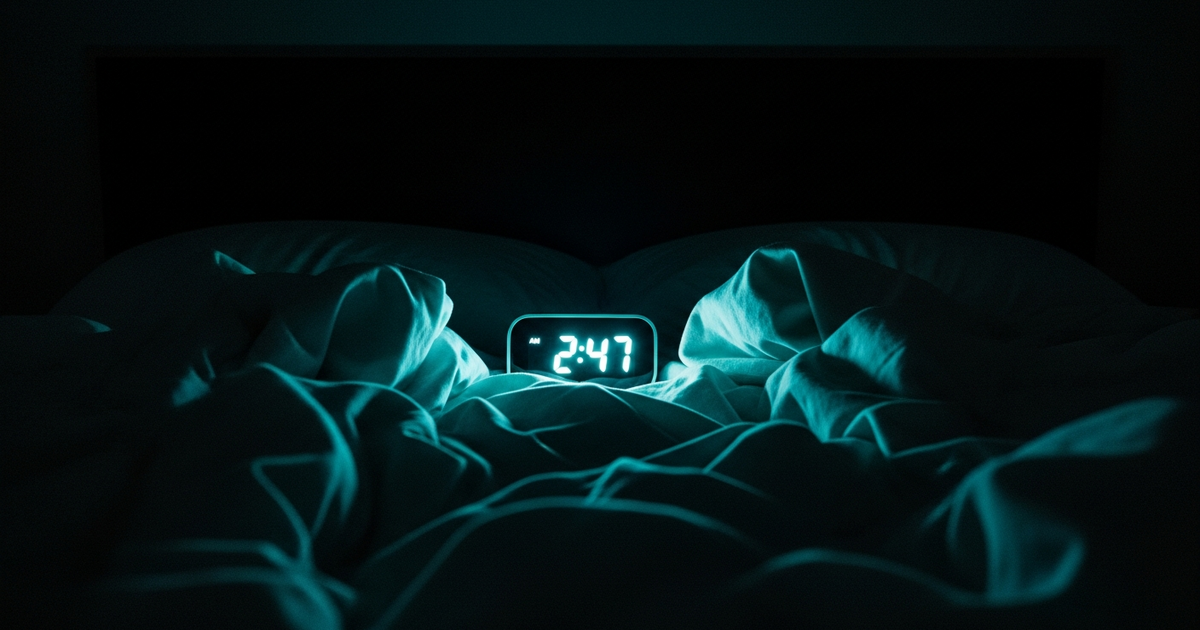
An estimated 30-40% of adults experience sleep anxiety at some point, and for about 10%, it becomes chronic. If you're reading this at 2 AM with your phone under the covers, you're not alone. And more importantly, you're not broken. Your brain is doing something predictable, explainable, and — with the right approach — fixable.
What Sleep Anxiety Actually Is
Sleep anxiety sits at the intersection of two phenomena: hyperarousal and conditioned insomnia.
Hyperarousal: The Engine
Hyperarousal is the leading neurobiological model for understanding insomnia. It describes a state where the brain's arousal systems are chronically overactive — not just at night, but throughout the entire 24-hour cycle.
People with hyperarousal-driven insomnia show measurable differences from good sleepers:
- Higher metabolic rate — the body burns more energy even at rest
- Elevated cortisol levels — particularly in the evening, when cortisol should be declining
- Faster EEG frequencies during sleep — more beta and gamma activity where alpha, theta, and delta should dominate
- Higher heart rate and lower HRV — the sympathetic nervous system is persistently dominant
- Increased brain glucose metabolism — neuroimaging shows the brain is more active during sleep than it should be
A landmark 2001 study by Nofzinger et al. in the American Journal of Psychiatry used PET scans to show that insomnia patients had 24% higher brain metabolic activity during sleep compared to healthy controls. Their brains literally wouldn't turn off.
This isn't a willpower problem. It's a neurobiological state. The arousal dial is set too high, and normal sleep processes can't overpower it.
Conditioned Insomnia: The Lock
Over time, hyperarousal at bedtime creates a conditioned response — your brain learns to associate the bed with wakefulness and anxiety rather than sleep.
This is classical conditioning at work. The bed (neutral stimulus) gets paired repeatedly with anxiety and frustration (negative response). After enough repetitions, the bed itself triggers the anxiety response. You feel the spike the moment you lie down.
This explains several patterns that sleep anxiety sufferers recognize:
"I was drowsy on the couch but wide awake in bed." — The couch doesn't carry the conditioned association. The bed does.
"I sleep better in hotels." — Novel environments don't carry the negative conditioning.
"I dread bedtime starting at dinner." — Anticipatory anxiety. Your brain starts preparing for the expected struggle hours in advance.
"The harder I try to sleep, the more awake I become." — Effort is arousal. Trying to sleep is the opposite of sleeping, which happens when you stop trying.
The Two Types of Sleep Anxiety
Not all sleep anxiety feels the same. Understanding which type you experience helps you choose the right intervention.
Cognitive Sleep Anxiety
What it feels like: Racing thoughts. Mental rehearsal of tomorrow. Replaying past conversations. Worrying about health, finances, relationships. The "what if" spiral. An inability to stop thinking.
What's happening neurologically: Your default mode network (DMN) — the brain network active during self-referential thinking and mind-wandering — is overactive. In healthy sleep, DMN activity decreases as the brain transitions from waking to sleep. In cognitive sleep anxiety, the DMN stays lit up, generating thoughts that perpetuate the arousal state.
Key markers: You can feel physically tired but mentally "wired." Your body wants to sleep but your mind won't cooperate. You might lie still for hours, thinking.
Somatic Sleep Anxiety
What it feels like: Physical tension, restlessness, elevated heart rate, chest tightness, hot flashes, tingling sensations, feeling "keyed up" without specific worried thoughts. An inability to get comfortable. Restless legs. Jaw clenching.
What's happening neurologically: Your sympathetic nervous system is directly activated. The fight-or-flight response is running at a physiological level, independent of conscious thought content. Your body is producing cortisol and adrenaline, increasing muscle tension, and maintaining cardiovascular readiness for action.
Key markers: You might not have identifiable worried thoughts. The anxiety is in the body, not the mind. You feel physically unable to relax, even when you're mentally calm.
Most People Have Both
In practice, cognitive and somatic anxiety feed each other. Worried thoughts trigger physical tension. Physical tension generates more worried thoughts. The cycle escalates until you're simultaneously thinking catastrophically AND feeling your heart pound.
Effective intervention addresses both types — calming the mind AND calming the body. This is why single-approach solutions often fail: a breathing exercise (somatic intervention) won't stop racing thoughts, and journaling (cognitive intervention) won't release muscle tension.
The Hyperarousal Cycle: How Sleep Anxiety Sustains Itself
Sleep anxiety is self-perpetuating. Understanding the cycle is the first step to breaking it.
Stage 1: The Bad Night
You have a poor night's sleep — maybe due to stress, caffeine, travel, or nothing identifiable. This is normal. Everyone has bad nights.
Stage 2: The Anticipation
The next evening, you start thinking about sleep. "I hope tonight is better." This thought seems harmless, but it introduces performance pressure. You're now monitoring your sleep, which creates arousal.
Stage 3: The Effort
You get into bed and "try" to sleep. You close your eyes tightly. You consciously try to clear your mind. Each attempt is an act of effort — and effort is arousal. The trying is what prevents the sleeping.
Stage 4: The Frustration
Minutes pass. Then an hour. You're not sleeping. Frustration builds. You check the clock (which makes it worse every time). You calculate how many hours of sleep you can still get "if I fall asleep right now." The math generates more anxiety.
Stage 5: The Catastrophizing
"I'm going to feel terrible tomorrow." "I can't function on this little sleep." "What if this never gets better?" "Something is wrong with me." The cognitive spiral generates cortisol, which further prevents sleep onset.
Stage 6: The Exhausted Morning
You eventually sleep, poorly and briefly. You wake exhausted, confirming your fears. This reinforces the belief that you "can't sleep" and strengthens the anticipatory anxiety for the next night.
Stage 7: Repeat
The cycle strengthens with each repetition. Within days to weeks, the conditioned association is established: bed = anxiety = sleeplessness. The occasional bad night has become a pattern.
Breaking the Cycle
The cycle has multiple intervention points. You don't need to address all of them — disrupting any single stage weakens the entire loop:
- Stage 2 (Anticipation): Cognitive defusion techniques — "I notice I'm having thoughts about sleep" rather than "I can't sleep tonight"
- Stage 3 (Effort): Paradoxical intention — give yourself permission NOT to sleep. "I'll just rest." Removing the pressure removes the effort, which removes the arousal
- Stage 4 (Frustration): Stimulus control — get out of bed after 20 minutes of wakefulness. Read in dim light. Return when drowsy. This prevents the bed-frustration association from strengthening
- Stage 5 (Catastrophizing): Reality testing — "I've functioned on bad sleep before. Tomorrow will be hard but manageable." Catastrophizing amplifies the emotional response; realistic assessment reduces it
- Stage 6 (Morning): Behavioral activation — maintain your schedule regardless of sleep quality. Don't cancel plans or nap excessively. This prevents the daytime consequences from reinforcing the nighttime pattern
Why 3 AM Is the Worst Time
The 3 AM wake-up is one of the most common and most distressing symptoms of sleep anxiety. It's so common that it has its own informal name: "the witching hour of insomnia."
There are specific neurobiological reasons why 3 AM (approximately — it varies from 2 AM to 4 AM) is a vulnerable time:
Cortisol nadir: Your cortisol levels reach their lowest point around midnight-1 AM, then begin a gradual rise in preparation for waking. Around 3 AM, this rise crosses a threshold that can trigger a subtle sympathetic activation — enough to cause a micro-arousal that, in someone with sleep anxiety, escalates into full wakefulness.
REM dominance: Later sleep cycles are REM-heavy. REM sleep involves emotional processing and is associated with increased sympathetic activity. Dreams during this period can be more vivid and emotionally charged, and the transition out of REM is a natural vulnerability window for waking.
Blood sugar: For some individuals, blood sugar drops during the night (particularly after high-carbohydrate dinners or alcohol consumption). The resulting counter-regulatory hormonal response (adrenaline, cortisol) can trigger a wake-up.
Bladder pressure: Simply: after 4-5 hours of sleep, bladder fullness can contribute to arousal. The physical discomfort combines with the cortisol rise to create a wake-up trigger.
The psychological amplifier: Waking at 3 AM feels different from waking at 6 AM. The darkness, the silence, and the knowledge that hours remain before your alarm create a unique psychological environment where anxiety thrives. You're alone with your thoughts in the darkest part of the night. For someone with sleep anxiety, this is the worst possible setup.
The solution isn't to prevent the wake-up (which is partly physiological and normal) — it's to prevent it from escalating into extended wakefulness. Techniques for managing the 3 AM wake-up focus on preventing the arousal cascade: keeping your eyes closed, using the physiological sigh, and having a sound healing track playing that provides both auditory masking and neurological support for falling back to sleep.
Practical Interventions: What Actually Works
Based on the current evidence, here are the most effective approaches for sleep anxiety, organized by mechanism:
For Cognitive Anxiety (Racing Thoughts)
1. Thought Downloading (Worry Dump)
30 minutes before bed, write down everything on your mind. Not a to-do list — a brain dump. The Zeigarnik effect (the brain's tendency to fixate on uncompleted tasks) means that unwritten worries keep circling. Writing them externalizes the loop. A 2018 study found that participants who wrote to-do lists before bed fell asleep 9 minutes faster.
2. Cognitive Shuffling
A technique developed by cognitive scientist Luc Beaudoin: think of a random word (e.g., "GARDEN"). For each letter, visualize random, unrelated objects starting with that letter (G: giraffe, guitar, glacier...). This occupies the default mode network with non-threatening content, displacing the anxious narratives.
3. [Racing Thought Techniques](/blog/racing-thoughts-bedtime)
Seven evidence-based methods for interrupting the thought spiral, from 5-4-3-2-1 grounding to cognitive defusion to sound-based attention anchoring.
For Somatic Anxiety (Body Tension)
4. [Body Scan Meditation](/blog/body-scan-sleep)
A systematic, guided relaxation of every body region from toes to head. This shifts brain activity from the DMN (rumination) to the somatosensory network (body awareness), which is inherently non-anxious. Detailed step-by-step guide in the linked article.
5. Progressive Muscle Relaxation (PMR)
Systematically tense and release each muscle group for 5-10 seconds each. The deliberate tension-release cycle creates a deeper relaxation than passive relaxation alone. The contrast between tension and release teaches the nervous system what "relaxed" actually feels like.
6. [The Physiological Sigh](/blog/physiological-sigh)
Stanford's fastest evidence-based calm-down technique. Double inhale through the nose → long exhale through the mouth. 5 minutes of cyclic sighing outperformed meditation, box breathing, and hyperventilation in controlled studies.
For Both Types
7. Sound Healing
Sound healing for sleep addresses both cognitive and somatic anxiety simultaneously. The brainwave entrainment component shifts neural activity from anxious beta frequencies toward sleep-compatible theta and delta frequencies. The auditory masking prevents environmental triggers. And the consistent, predictable soundscape provides a "safety signal" to the nervous system. For sleep anxiety specifically, the value of sound healing is that it requires zero effort — you press play and let the frequencies do the work, avoiding the effort-arousal paradox that makes "trying to relax" counterproductive.
8. Stimulus Control Therapy
The gold-standard behavioral intervention for conditioned insomnia:
- Use the bed only for sleep (and intimacy) — no reading, no phone, no TV
- Go to bed only when genuinely drowsy
- If you can't sleep within 20 minutes, get up. Go to another room. Read something boring in dim light. Return only when drowsy.
- Wake at the same time every morning, regardless of sleep quality
- No napping (or limit to 20 minutes before 2 PM)
This protocol weakens the bed-anxiety association and rebuilds the bed-sleep association. It's uncomfortable for the first 1-2 weeks (you may spend a lot of time in the chair). By week 3-4, the reconditioning takes hold.
9. [Breaking the Insomnia-Anxiety Cycle](/blog/insomnia-anxiety-cycle)
A comprehensive guide to interrupting the self-reinforcing loop at every stage — from anticipatory anxiety to catastrophizing to morning reinforcement.
Sleep Dread: The Meta-Anxiety
For some people, sleep anxiety evolves into something more intense: sleep dread. This is anxiety about the anxiety — a meta-layer of fear where the anticipated suffering of trying to sleep becomes worse than actual sleep loss.
Sleep dread often manifests as:
- Deliberately staying up late to avoid the experience of lying awake
- Falling asleep on the couch to avoid getting into bed
- Feeling a sense of doom or panic as bedtime approaches
- Avoiding sleep-related topics (including articles like this one) because they trigger distress
Sleep dread is a sign that conditioned insomnia has become deeply entrenched. The bed isn't just associated with wakefulness — it's associated with suffering. At this level, self-help techniques alone may be insufficient, and working with a therapist trained in CBT-I (Cognitive Behavioral Therapy for Insomnia) is strongly recommended.
CBT-I is the gold standard treatment for chronic insomnia — more effective than sleeping pills in long-term studies, with no side effects, no dependency, and improvements that persist after treatment ends. If sleep dread describes your experience, please seek professional support.
The Role of Daytime Behavior
Sleep anxiety isn't just a nighttime problem. What you do during the day shapes your nervous system state at bedtime.
Morning: Set the Autonomic Tone
- Wake at the same time daily (including weekends) — circadian consistency improves overall ANS regulation
- Get bright light exposure within 30 minutes of waking — this anchors your circadian rhythm and strengthens the melatonin signal at night
- Brief morning exercise or cold water exposure — builds vagal tone that pays dividends at bedtime
Afternoon: Prevent Arousal Accumulation
- No caffeine after 2 PM (6-hour half-life means 3 PM coffee is 50% active at 9 PM)
- Take 3-5 conscious breaths every 2 hours — this prevents sympathetic accumulation throughout the day
- One 10-minute walk outdoors — daylight exposure + gentle movement + nature sounds all support parasympathetic tone
Evening: Systematic Wind-Down
- 2 hours before bed: Reduce light intensity. No overhead lights. Use lamps.
- 1 hour before bed: No screens. No stimulating content. No work email.
- 30 minutes before bed: Nervous system reset protocol — breathing, body scan, or other vagal activation
- At bedtime: Sound healing track on. Lights off. Let go.
The 24-Hour Perspective
Sleep anxiety feels like a nighttime problem, but it's often the result of a 16-hour sympathetic marathon that leaves your nervous system with no runway for the parasympathetic transition required for sleep. The daytime practices aren't optional extras — they're the foundation that makes nighttime techniques effective.
The Science of What Helps: Research-Backed Approaches
The last decade has produced a wealth of clinical research on sleep anxiety interventions. Here's what the evidence actually supports, ranked by strength of evidence:
Tier 1: Strong Evidence
Cognitive Behavioral Therapy for Insomnia (CBT-I)
The gold standard. Multiple meta-analyses — including a 2015 Cochrane review — confirm CBT-I is more effective than sleeping pills for chronic insomnia, with benefits that last long after treatment ends. CBT-I combines sleep restriction, stimulus control, cognitive restructuring, and relaxation training into a structured 6-8 session protocol.
Response rates: 70-80% of patients show clinically significant improvement. Complete remission (no longer meeting insomnia criteria): 40-60%.
Available as: in-person therapy, telehealth, and validated digital programs (Sleepstation, Pear Therapeutics, VA's Insomnia Coach app). Digital CBT-I has been shown to be nearly as effective as in-person therapy in multiple randomized controlled trials.
Sleep Restriction Therapy
The most powerful single component of CBT-I. By compressing the sleep window to match actual sleep time, you build overwhelming sleep pressure that overrides anxiety. Uncomfortable for the first week, transformative by week three.
Stimulus Control Therapy
Breaking the bed-wakefulness association by getting up when you can't sleep. Simple, free, and consistently effective across studies. The key is consistency — the rule must be followed every night for the reconditioning to work.
Tier 2: Moderate Evidence
Mindfulness-Based Stress Reduction (MBSR)
A 2019 meta-analysis in Annals of Internal Medicine found that mindfulness meditation improved sleep quality comparably to sleep medication in some populations. The body scan component appears to be particularly effective for sleep.
Sound-Based Interventions
Brainwave entrainment, singing bowl meditation, and frequency-based sleep audio show positive results in multiple studies, though sample sizes tend to be smaller than CBT-I research. The mechanism (Frequency Following Response) is well-established; the clinical application for sleep anxiety specifically is in the "promising, growing evidence" phase.
The practical advantage of sound-based approaches: zero effort required. For people who find that behavioral techniques become another source of performance anxiety, sound healing provides support without demanding anything from the user.
Breathing Techniques
The physiological sigh (Stanford, 2023) and 4-7-8 breathing both have direct evidence for reducing physiological arousal. They're most effective as components of a broader routine rather than standalone interventions.
Tier 3: Emerging Evidence
Heart Rate Variability Biofeedback
Training to increase HRV through real-time feedback has shown positive results in several small studies. The principle: by learning to control your HRV, you gain direct influence over your autonomic nervous system state.
Acceptance and Commitment Therapy (ACT) for Insomnia
ACT's approach — accepting insomnia rather than fighting it — shows promising results in early trials. The "drop the rope" philosophy directly addresses the effort-arousal paradox that drives sleep anxiety.
Yoga Nidra
"Yogic sleep" — a guided meditation practice that progressively relaxes the body while maintaining consciousness — has shown sleep improvements in several clinical studies, particularly for military populations with PTSD-related insomnia.
What Doesn't Work (Despite Popularity)
Sleep hygiene alone: Sleep hygiene (dark room, cool temperature, no screens) is necessary but not sufficient for sleep anxiety. It's like brushing your teeth when the problem is a cavity — good practice, wrong treatment level.
Melatonin for anxiety-driven insomnia: Melatonin addresses circadian timing, not arousal. It may help with jet lag or delayed sleep phase, but it doesn't reduce the hyperarousal that drives sleep anxiety.
Alcohol as sedation: Alcohol is a sedative, but it suppresses REM sleep, fragments sleep architecture, and causes rebound sympathetic activation in the second half of the night. It makes sleep anxiety worse in the medium and long term.
Herbal supplements (valerian, chamomile, passionflower): Evidence is mixed to weak for most herbal sleep aids. They may provide mild calming effects but don't address the core hyperarousal mechanism.
When Sleep Anxiety Becomes a Sleep Disorder
Everyone experiences occasional sleep anxiety — before a big presentation, after a stressful event, during a life transition. This is normal and self-limiting.
Sleep anxiety becomes a clinical concern when:
- It persists for 3+ months at a frequency of 3+ nights per week
- It causes significant daytime impairment (fatigue, concentration problems, mood disturbance)
- It leads to compensatory behaviors that worsen the problem (excessive caffeine, alcohol as sedation, extended time in bed)
- It impacts relationships, work, or quality of life
If this describes your situation, consider:
CBT-I (first-line treatment): 6-8 sessions, either in-person or via digital platforms (like Sleepstation, Pear Therapeutics, or Insomnia Coach). Multiple meta-analyses show CBT-I is more effective than medication for chronic insomnia, with benefits that persist long after treatment ends.
Medical evaluation: Rule out contributing factors — sleep apnea, restless leg syndrome, thyroid dysfunction, medication side effects, and other conditions that can mimic or worsen sleep anxiety.
Therapy for underlying anxiety: If generalized anxiety disorder, PTSD, or depression underlies the sleep anxiety, treating the primary condition often resolves the sleep symptoms.
Sleep Anxiety in Different Life Stages
Sleep anxiety doesn't affect everyone the same way. Understanding how it manifests at different life stages can help you identify the right approach.
Young Adults (18-30)
Sleep anxiety in this age group is often driven by performance pressure — academic demands, career uncertainty, social comparison, and financial instability. The digital environment amplifies it: social media consumption before bed simultaneously suppresses melatonin (blue light), triggers social comparison anxiety (content), and fragments the wind-down period (notifications).
Common pattern: Delayed sleep onset (going to bed at midnight-2 AM because the evening feels like the only "free" time), then anxiety about getting enough sleep before early morning obligations. This creates a chronic sleep deficit that compounds weekly.
Key intervention: Digital sunset — all screens off 60 minutes before bed. This single change addresses the blue light, content, and notification triggers simultaneously. Pair with a sound healing track to fill the auditory space that the phone previously occupied.
Parents of Young Children (25-45)
Sleep anxiety here is uniquely cruel: you're exhausted, you finally have an opportunity to sleep (baby is asleep), and you can't because you're listening for the baby. Or you're anxious about whether the baby will wake in 20 minutes, making it "not worth" falling asleep.
Common pattern: Hypervigilance — the nervous system stays in "sentinel mode," maintaining enough sympathetic activation to respond instantly to a cry. This is biologically adaptive (it protects the infant) but devastating for sleep quality, especially when it persists after the child's sleep has stabilized.
Key intervention: Graduated release of hypervigilance. Start with a reliable baby monitor and progressive acceptance of brief response delays. For the parent in bed, sound healing tracks can serve dual purposes: masking minor baby sounds that would trigger unnecessary alertness while supporting the parent's sleep onset. Vagus nerve techniques are particularly effective for parents because the hypervigilance is physiological, not just cognitive.
Midlife (40-60)
Hormonal changes (perimenopause, menopause, andropause) add a physiological layer to sleep anxiety. Hot flashes, night sweats, and hormonal mood fluctuations can independently disrupt sleep — and when these disruptions trigger anxiety about sleep, the cycle compounds.
Common pattern: Sleep was fine for decades, then suddenly wasn't. The contrast between "I used to sleep well" and "now I can't" generates confusion and alarm that intensifies the anxiety response.
Key intervention: Medical evaluation first — hormonal interventions can address the physiological triggers. Then behavioral approaches for the anxiety layer that has developed on top. Temperature management becomes more critical: cooling mattress pads, breathable bedding, and bedroom temperature of 18°C (65°F). HRV tracking can help distinguish hormonal disruption nights from anxiety-driven nights.
Older Adults (60+)
Sleep architecture naturally changes with age — less deep sleep, more frequent awakenings, earlier wake times. These are normal age-related changes, not insomnia. But when older adults interpret normal aging as a sleep problem, anxiety about sleep develops — creating actual insomnia on top of normal architectural changes.
Common pattern: "I used to sleep 8 hours straight. Now I wake up three times." This concern generates monitoring behavior, effort to recapture earlier sleep patterns, and frustration that feeds the cycle.
Key intervention: Sleep education — understanding that 6-7 hours with brief awakenings is normal and healthy for this age group. Acceptance of the new pattern reduces the anxiety that transforms a normal change into a disorder. Body scan meditation is particularly effective for older adults because it requires no physical exertion and can be done entirely in bed.
The Paradox That Sets You Free
Here is the central paradox of sleep anxiety: the less you care about sleeping, the easier it becomes.
This isn't platitude. It's neuroscience. Caring about sleep creates performance pressure. Performance pressure creates arousal. Arousal prevents sleep. The caring is the cause.
The most effective single intervention for sleep anxiety is giving yourself genuine permission not to sleep. Not as a trick. Not as a strategy to "reverse psychology" yourself to sleep. As a genuine release of the demand.
"If I sleep, great. If I don't, I'll rest and tomorrow will be fine."
This isn't denial. It's realistic. Humans are remarkably resilient to short-term sleep loss. One bad night doesn't ruin your health, your performance, or your life. The catastrophizing about sleep loss causes more damage than the sleep loss itself — through chronic cortisol elevation, prolonged sympathetic activation, and the psychological burden of dread.
Let go of the demand. Rest in the dark. Play a delta frequency track. Close your eyes. Let whatever happens, happen.
Most nights, when you genuinely stop caring, sleep arrives within minutes. It was always waiting — you just had to stop standing in its way.
Start Sleeping Better Tonight
Join 14,500+ people who've transformed their sleep with healing frequencies, delta wave entrainment, and our progressive 21-night program.