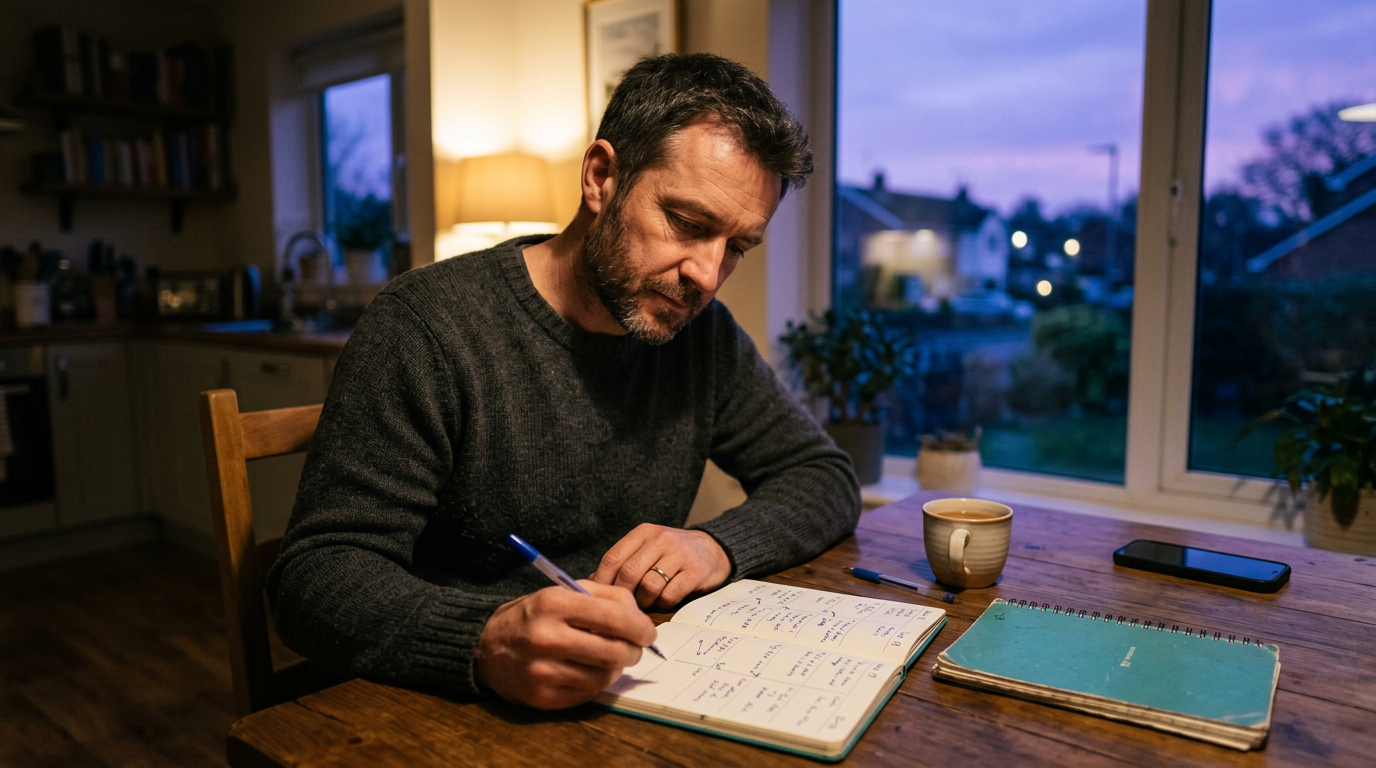
A mind in distress runs the same three thoughts on a loop, each one slightly worse than the last, none of them finishing. Put those thoughts on paper and something changes. The loop becomes a sentence with an end. What felt enormous and formless turns out to have edges, and edges can be looked at. This is most of what journaling does for mental health, and it explains why a practice this simple keeps showing up in clinical research. What that research actually says is more interesting than the usual advice, including one finding worth knowing before you start writing about your worst memories.
How does journaling help mental health?
Writing moves a thought out of the loop and into language, which forces it into a shape you can examine. That process helps you name what you feel, notice patterns across days, and offload the open loops your mind has been holding onto, which reduces the effort of carrying them.
Three distinct mechanisms hide inside the single word journaling, and they behave differently. Naming an emotion accurately tends to reduce its intensity. Seeing your own patterns across weeks gives you information no single day provides. And writing something down releases your mind from rehearsing it, which is the plainest and most immediate benefit.
That third mechanism has direct evidence. In a study published in Journal of Experimental Psychology, people who wrote a specific to do list before bed fell asleep faster than those who wrote about completed tasks. The more specific the list, the faster they slept, which suggests the mind lets go once it trusts the paper.
What does the research actually show?
Benefits are real and mostly modest, and the type of writing matters. A 2023 systematic review and meta analysis of twenty four randomized trials found that in general populations, writing about positive experiences produced better mood outcomes than writing about traumatic ones, which complicates the popular advice.
That analysis, published in Nursing Open, compared expressive writing about stressful events against positive writing. In general populations the expressive writing groups reported higher negative emotion and lower positive emotion afterward, while patient populations showed different patterns of cognitive processing.
Read honestly, this says something practical. Writing about a painful experience makes you feel the painful experience, which is the point when you are processing something with support, and unhelpful when you are simply hoping to feel better this evening. Match the method to what you actually need on a given day.
Which journaling method should you choose?
Choose by purpose. Use a nightly brain dump to sleep better, gratitude or positive writing to lift mood, structured reflection to find patterns, and expressive writing about hard experiences when you have the time and support to process instead of simply stir.
Here is how those break down in practice.
The brain dump. Five minutes, everything open in your head, unsorted. Best before bed or at the end of the workday.
Positive or gratitude writing. Three specific good things and why they happened. The meta analysis favored this format for mood in general populations.
Structured reflection. The same few questions weekly. What went well, what drained me, what am I avoiding. This is where patterns surface.
Expressive writing. The classic protocol runs fifteen to twenty minutes for three or four days about one stressful event. Powerful and demanding, and best used deliberately.
Most people benefit from keeping two of these: something short and daily, and something reflective and weekly.
The pairing works because the two formats answer different questions. The daily entry asks what is here right now, which keeps the loops from accumulating. The weekly one asks what has been happening across these seven days, which is where the useful information lives. Skipping the weekly review is the most common reason a journaling habit produces a lot of pages and very little insight.
How do you start when a blank page feels impossible?
Lower the bar until it feels almost silly. Three lines, one prompt, five minutes with a timer. Write badly on purpose, since nobody reads this and quality actively gets in the way. The habit matters far more than the writing does.
The blank page problem is nearly universal, and prompts solve it. What am I carrying right now. What happened today that mattered. What am I avoiding. What went better than expected. Any one of these gives your pen somewhere to start, and starting is the whole difficulty.
Attach it to something already in your day so remembering never becomes the obstacle, an approach covered in our guides to habit stacking and implementation intentions. After I brush my teeth, I write three lines. That sentence does more for consistency than any amount of enthusiasm.
What if writing makes you feel worse?
Stop and switch methods. Turning a difficult memory over without moving anywhere is rumination with better handwriting, and the research shows expressive writing can raise negative emotion in the short term. Switch to gratitude, to plans, or to a conversation with a professional.
The line between processing and ruminating is worth learning to feel. Processing moves: the account gains detail, meaning, or a next step, and you finish slightly lighter. Rumination circles: the same sentences with the same emotional charge, and you finish heavier. If your journal reads like the same paragraph forty times, the format is working against you.
A simple test helps mid entry. Ask whether you are describing something or arguing with it. Description moves you along; arguing with a memory keeps you in the room with it.
This matters most for trauma. Writing about serious traumatic experiences alone can open more than a person can hold, and the meta analytic evidence for these interventions is strongest alongside professional care. If a memory reliably overwhelms you, bring it to a therapist instead of a notebook. That is the strong move, and our guide to meditation for overthinking covers gentler options for a loud mind in the meantime.
How long until journaling makes a difference?
Sleep effects can appear the first night, since offloading works immediately. Mood effects usually take a few weeks of regular practice. Pattern recognition needs a month or two of entries before you can look back and see what your weeks have actually been doing.
The pattern benefit is the one people underestimate and later value most. Any single entry is a snapshot with limited information. Six weeks of entries reveal that your worst days follow poor sleep, that a particular meeting reliably drains you, or that the thing you keep avoiding has appeared eleven times. No amount of thinking produces that view, because memory rewrites the past to match the present mood.
Rereading is therefore part of the practice. Once a month, read back over your entries and write a few lines about what you notice. That single habit converts a diary into an instrument, and connects to the self observation skill in our guide to metacognition.
Where does journaling fit in a mental longevity practice?
Journaling trains self knowledge and emotional regulation, and it makes intentional living concrete by turning vague values into written decisions you can revisit. It also protects sleep by giving your open loops somewhere to rest, which supports nearly everything else.
Mental longevity is the lifelong capacity to think clearly, regulate your inner state, adapt to change, keep learning, maintain meaningful connections, and live intentionally. A journal touches several of those at once and does something none of the others do: it produces a record. Years of entries let you watch your own development, catch drift early, and remember what mattered to you before circumstances rewrote it, which is why it recurs throughout what mental longevity means.
Reflection also deepens when it meets other people. Members inside HumanOS, our community for building a durable mind, pair private writing with a shared weekly review, which turns private noticing into something you can actually act on.
Is it better to write by hand or type?
Both work, and the differences are small next to consistency. Handwriting slows you down, which some people find helps them think, while typing suits anyone who writes faster than they can hold a pen. Use whichever you will actually do tonight.
How long should each entry be?
Five to fifteen minutes covers nearly every purpose. The classic expressive writing protocol used fifteen to twenty minutes for a few days. For a daily practice, three honest lines beat a page you dread, since the practice you sustain is the one that produces results.
Do journaling apps work as well as paper?
Yes, with one caveat: an app lives on a device engineered to interrupt you, so the risk is starting a journal entry and finishing inside a feed. If that describes you, keep the notebook, or use the approaches in our guide to digital minimalism to make the device safer.
Should I keep it private?
Privacy is what makes honesty possible, so protect it plainly: a notebook nobody opens, or a locked file. Writing that anticipates an audience quietly turns into performance, and performance produces exactly the polished account you did not need to write.