Sleep Paralysis: What's Happening in Your Brain (And How to Stop It)
Sleep paralysis isn't supernatural—it's a neurological glitch. Understand the science behind why you can't move, why you see shadows, and how to prevent future episodes.
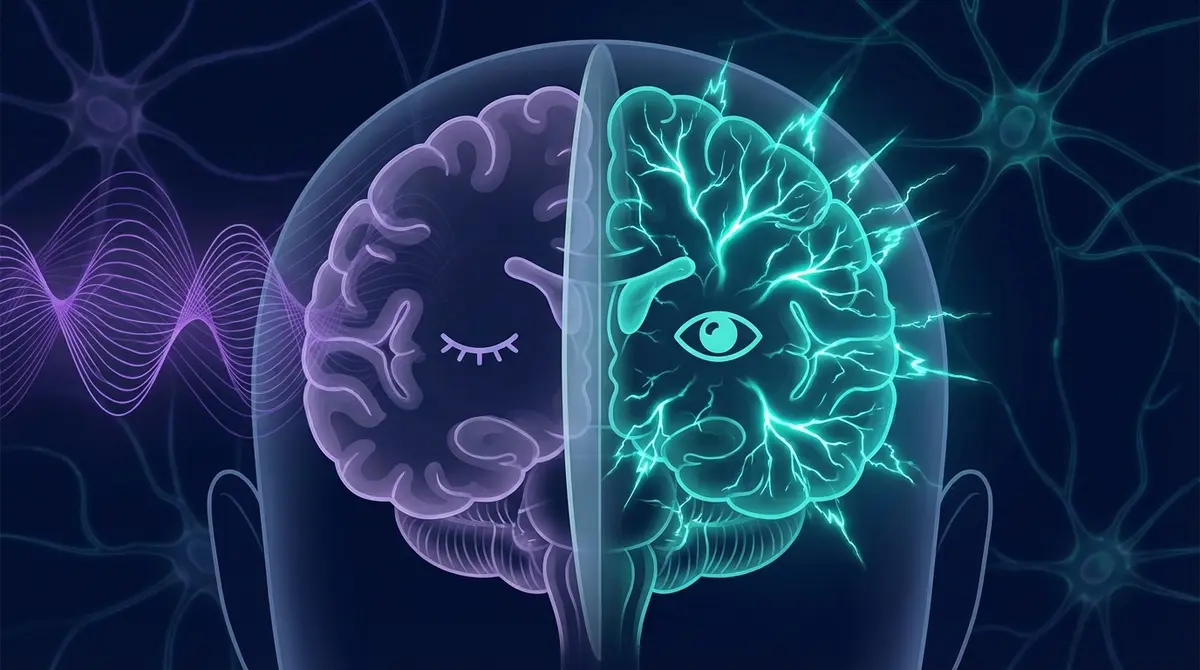
You wake up. But you can't move. You can't speak. You can't even scream. Your eyes are open, but your body is frozen. And then you see it—a shadow in the corner of your room. A presence. A weight on your chest. Pure, primal terror.
If you've experienced sleep paralysis, you know: it feels like the most terrifying thing that's ever happened to you. And if you haven't, the description alone is enough to make your skin crawl.
Here's the truth: sleep paralysis isn't supernatural. It's not a spiritual attack. It's not even rare—studies suggest that between 8% and 50% of people will experience it at least once in their lifetime. It's a neurological event. A glitch in the mechanics of sleep. And once you understand what's happening in your brain, the fear loses its grip.
What Is Sleep Paralysis?
Sleep paralysis occurs when your brain wakes up before your body does. Specifically, it happens during the transition into or out of REM (rapid eye movement) sleep—the stage where most dreaming occurs.
During REM sleep, your brain paralyzes your muscles. This is a protective mechanism called REM atonia, and it's designed to stop you from physically acting out your dreams. Imagine dreaming you're running, and your legs actually start kicking. REM atonia prevents that.
But sometimes, the system misfires. Your consciousness returns before the paralysis ends. You're awake—aware of your surroundings, able to see and hear—but your body is still in lockdown. This is sleep paralysis.
Dr. Matthew Walker, a sleep researcher at UC Berkeley, explains that sleep paralysis is essentially REM intrusion—elements of REM sleep bleeding into wakefulness. Your brain is caught between two states: one that's awake and one that's still dreaming. The result is a brief but terrifying experience where reality and dream logic overlap.
Why Do You See Shadows and Feel a Presence?
The hallucinations are the part that haunts people. The shadowy figures. The sense of a malevolent presence. The feeling of a weight pressing on your chest. These aren't random—they're the result of specific brain activity during sleep paralysis.
Research from the University of California, San Diego, and other institutions has identified three types of hallucinations commonly associated with sleep paralysis:
1. Intruder Hallucinations
You sense a presence in the room. A figure standing in the corner. Footsteps. A feeling of being watched. This is the most common type of sleep paralysis hallucination.
Why does it happen? Your brain's threat-detection system—the amygdala—is hyperactive during REM sleep. When you wake up paralyzed, your amygdala is still firing, scanning for danger. But because you can't move, your brain interprets this as: something is preventing me from moving. There must be a threat.
This is called the hypervigilant state. Your brain creates a threat to explain the paralysis. It's pattern-matching gone wrong—your amygdala is doing its job (detecting danger), but the danger doesn't actually exist.
2. Incubus Hallucinations (Chest Pressure)
You feel a weight on your chest. Difficulty breathing. A sense of being crushed or suffocated. This is where the term "night hag" or "sleep demon" comes from—across cultures, people have described sleep paralysis as a malevolent entity sitting on their chest.
The physiological explanation: during REM sleep, your breathing becomes irregular. When you wake up paralyzed, you're still in that irregular breathing pattern, but now you're conscious of it. Your chest muscles are weak (because of REM atonia), so breathing feels labored. Your brain interprets this as external pressure—something is on your chest, crushing you.
3. Vestibular-Motor Hallucinations (Out-of-Body Sensations)
You feel like you're floating, falling, or being pulled out of your body. Some people report feeling like they're being dragged across the room or hovering above their bed.
This happens because your vestibular system (the part of your brain that processes balance and spatial orientation) is confused. REM sleep involves rapid eye movements and disorientation. When you wake up mid-REM, your vestibular system is still receiving those chaotic signals. The result: a sensation of movement or dislocation that doesn't match physical reality.
The Neuroscience of Sleep Paralysis
Sleep paralysis happens when three systems fall out of sync:
- The cortex (consciousness) wakes up
- The brainstem (motor control) stays in REM atonia
- The amygdala (threat detection) remains hyperactive
Normally, these systems transition together. You either stay fully asleep, or you wake up fully. But in sleep paralysis, only part of your brain wakes up. The result is a hybrid state—awake consciousness trapped in a dreaming body.
Dr. Baland Jalal, a neuroscientist at the University of California, San Diego, has studied sleep paralysis extensively. His research shows that the hallucinations aren't "inserted" into your mind from an external source. They're created by your own brain as it tries to make sense of conflicting sensory information.
Think of it like this: your brain expects to be able to move. When it can't, it looks for an explanation. In the absence of real sensory input, it fills in the gaps with the most plausible story—usually a threat. This is why the hallucinations are almost always terrifying. Your brain is operating under the assumption that paralysis = danger.
Who Gets Sleep Paralysis (And Why)?
Sleep paralysis can happen to anyone, but certain factors make it more likely:
Sleep Deprivation
When you're sleep-deprived, your brain craves REM sleep. The moment you finally lie down, your brain tries to "catch up" by entering REM too quickly—a phenomenon called REM rebound. This rapid entry into REM increases the likelihood of REM intrusion and sleep paralysis.
Irregular Sleep Schedule
Shift workers, travelers crossing time zones, and anyone with an inconsistent sleep-wake schedule are at higher risk. When your circadian rhythm is disrupted, your brain struggles to coordinate the sleep stages properly. This increases the chance of waking up mid-REM.
Sleeping on Your Back
Research shows that sleep paralysis is significantly more common when people sleep in the supine position (on their back). The exact reason isn't fully understood, but it may be related to breathing patterns and brainstem activity in this position.
Stress and Anxiety
High-stress periods correlate with increased sleep paralysis episodes. Stress keeps the amygdala hyperactive, even during sleep. When you wake up paralyzed, that already-active threat-detection system kicks into overdrive, intensifying the hallucinations.
Narcolepsy and Other Sleep Disorders
People with narcolepsy—a condition where the brain struggles to regulate sleep-wake cycles—experience sleep paralysis far more frequently than the general population. Other sleep disorders, like obstructive sleep apnea, also increase the risk.
How to Prevent Sleep Paralysis
While you can't always prevent sleep paralysis, you can significantly reduce the frequency of episodes by addressing the underlying triggers.
1. Prioritize Sleep Consistency
Go to bed and wake up at the same time every day—even on weekends. Your brain's sleep-wake cycle thrives on consistency. When your circadian rhythm is stable, your brain is better able to coordinate the transitions between sleep stages.
2. Avoid Sleep Deprivation
Aim for 7–9 hours of sleep per night. Chronic sleep deprivation is one of the strongest predictors of sleep paralysis. When your brain is desperate for REM sleep, it's more likely to enter it abruptly—increasing the risk of REM intrusion.
3. Sleep on Your Side
Studies show that sleeping on your back increases the likelihood of sleep paralysis. If you're prone to episodes, try sleeping on your side. You can use a body pillow to help maintain the position throughout the night.
4. Manage Stress and Anxiety
Chronic stress keeps your nervous system in fight-or-flight mode, which primes your brain for threat-detection even during sleep. Practices like meditation, breathwork, and nervous system regulation can reduce baseline anxiety and lower the risk of hypervigilant sleep states.
5. Limit Stimulants and Alcohol
Caffeine, nicotine, and alcohol all disrupt REM sleep. Caffeine and nicotine are stimulants that interfere with your ability to enter deep sleep stages. Alcohol suppresses REM early in the night, then causes REM rebound later—both of which increase the risk of sleep paralysis.
6. Create a Consistent Bedtime Routine
Signal to your brain that it's time to transition to sleep. Dim the lights, avoid screens, lower the room temperature, and engage in a calming pre-sleep ritual. This reduces the likelihood of abrupt sleep-stage transitions.
What to Do During an Episode
If you find yourself in the middle of sleep paralysis, here's what can help:
1. Don't Panic (Easier Said Than Done)
Remind yourself: this is temporary. It's not dangerous. It will end. Sleep paralysis episodes typically last between a few seconds and a few minutes. No one has ever been harmed by sleep paralysis itself—only by the fear response.
2. Focus on Small Movements
You can't move your whole body, but you might be able to move your eyes, fingers, or toes. Focus all your attention on wiggling a finger or blinking rapidly. Often, this small movement is enough to "wake up" the rest of your motor system and break the paralysis.
3. Control Your Breathing
Your breath is one thing you can still influence. Slow, deep breaths activate the parasympathetic nervous system, which can help reduce the panic response and sometimes shorten the episode.
4. Reframe the Experience
Dr. Baland Jalal developed a technique called Meditation-Relaxation Therapy for sleep paralysis. The core idea: instead of fighting the paralysis, accept it. Remind yourself that the hallucinations aren't real. Reframe the experience as a curious neurological event rather than a threat.
In clinical trials, participants who practiced this reframing technique reported significantly less fear during subsequent episodes—and some even stopped having episodes altogether.
The Cultural History of Sleep Paralysis
Sleep paralysis has been documented across cultures for thousands of years. In medieval Europe, it was called the "night hag" or "old hag syndrome"—people believed a witch was sitting on their chest, stealing their breath. In Newfoundland folklore, it was the "old hag." In Japanese culture, it's "kanashibari" (bound by metal). In Turkish, "karabasan" (dark presser).
The consistency across cultures is striking—almost every society has a name for the phenomenon and an explanation rooted in supernatural entities. This tells us two things:
- Sleep paralysis is a universal human experience.
- Before we understood neuroscience, the brain's threat-detection system filled in the gaps with the most culturally available explanation: demons, spirits, witches.
Now we know better. The "demon" is your own amygdala. The "presence" is your brain's hypervigilant state. The "attack" is a neurological glitch. And when you understand that, the experience loses its power.
When to Seek Professional Help
Occasional sleep paralysis is common and not a cause for concern. But if you're experiencing frequent episodes (more than once a week), or if they're severely impacting your quality of life, it's worth seeing a sleep specialist.
Frequent sleep paralysis can be a symptom of:
- Narcolepsy: A disorder where the brain can't regulate sleep-wake cycles properly
- Sleep apnea: Interrupted breathing during sleep, which disrupts REM cycles
- PTSD or anxiety disorders: Chronic hyperarousal can destabilize sleep stages
A sleep study (polysomnography) can help identify underlying sleep disorders that might be contributing to the paralysis.
Your Next Step
If you've experienced sleep paralysis, you're not alone. And you're not in danger. It's a neurological event—unsettling, but temporary and harmless.
Start with the prevention strategies above. Stabilize your sleep schedule. Prioritize rest. Sleep on your side. Manage stress. Over time, the frequency of episodes should decrease.
If you're looking for a structured approach to improving your sleep and regulating your nervous system, explore our 21 Nights to Deep Sleep program. It combines sleep-specific protocols, healing frequencies, and nervous system regulation techniques designed to create the foundation for restful, restorative sleep.
Or start free: download our Sleep Better Tonight guide for science-backed strategies you can use immediately.
Your brain knows how to sleep. Sometimes it just needs a reminder of how to let go.
Start Sleeping Better Tonight
Join 14,500+ people who've transformed their sleep with healing frequencies, delta wave entrainment, and our progressive 21-night program.