HRV and Sleep Quality: What Your Heart Rate Tells You
Your heart doesn't beat like a metronome. If your heart rate is 60 beats per minute, the intervals between beats aren't exactly 1.000 seconds each. They vary — 0.98 seconds, then 1.03, then 0.97, then...
# HRV and Sleep Quality: What Your Heart Rate Tells You
Your heart doesn't beat like a metronome. If your heart rate is 60 beats per minute, the intervals between beats aren't exactly 1.000 seconds each. They vary — 0.98 seconds, then 1.03, then 0.97, then 1.01. These tiny variations, measured in milliseconds, contain a surprising amount of information about your nervous system, your stress levels, and your readiness for sleep.
This measurement is called Heart Rate Variability (HRV), and it's one of the most powerful biomarkers available for understanding why you sleep well on some nights and terribly on others.
What HRV Actually Measures
HRV is the variation in time intervals between consecutive heartbeats. It's typically measured in milliseconds (ms) using the RMSSD metric (root mean square of successive differences) or the SDNN metric (standard deviation of normal-to-normal intervals).
The counterintuitive insight: higher variability is better.
A heart that beats with robotic precision — exactly 1.000 seconds between every beat — actually indicates a stressed system. A heart with natural variation — 0.95, 1.05, 0.98, 1.02 — indicates a flexible, responsive nervous system that can easily shift between states.
Why? Because HRV reflects the balance between your two autonomic nervous system branches:
- Sympathetic activation (stress) → decreases HRV → heart beats more rigidly
- Parasympathetic activation (calm) → increases HRV → heart beats with more natural variation
When both branches are functioning well and in balance, your heart rate varies naturally with each breath (speeding slightly on inhale, slowing on exhale — a phenomenon called respiratory sinus arrhythmia). High HRV indicates this balance is present. Low HRV indicates the sympathetic system is dominating.
HRV as a Sleep Predictor
Research consistently shows that pre-sleep HRV predicts sleep quality with remarkable accuracy.
A 2019 study in Sleep Medicine found that participants with higher evening HRV:
- Fell asleep 40% faster
- Experienced 23% more deep sleep (N3 stage)
- Woke 50% fewer times during the night
- Reported significantly better subjective sleep quality
A 2021 study in Psychophysiology demonstrated that HRV measured during the 30 minutes before sleep onset was a stronger predictor of sleep efficiency than any self-reported measure, including perceived stress level or caffeine intake.
The practical takeaway: Your HRV in the hour before bed tells you how ready your nervous system is for sleep. High HRV = smooth transition. Low HRV = fight ahead.
What's a "Good" HRV?
HRV is highly individual. A 25-year-old athlete might have an average HRV of 80-100 ms. A 55-year-old with a sedentary lifestyle might average 25-35 ms. Both could be "normal" for their demographic.
General ranges (RMSSD, in ms):
| Age | Below Average | Average | Above Average |
|-----|---------------|---------|---------------|
| 20-30 | <40 | 40-80 | >80 |
| 30-40 | <30 | 30-65 | >65 |
| 40-50 | <20 | 20-50 | >50 |
| 50-60 | <15 | 15-40 | >40 |
| 60+ | <10 | 10-30 | >30 |
Important: Don't compare your HRV to others. Compare it to your own baseline. What matters is the trend — is your HRV improving over weeks? Is it higher on nights you sleep well vs. poorly? Track your personal pattern.
How HRV Changes Through the Night
HRV isn't static during sleep. It follows a predictable pattern that mirrors your sleep architecture:
Sleep onset → first 2 hours: HRV typically increases as the parasympathetic system takes over. This is the deep sleep period where vagal tone peaks.
Mid-sleep (hours 3-5): HRV remains elevated during deep sleep cycles and dips slightly during REM periods (REM involves more sympathetic activation — your brain is active, processing emotional content).
Pre-waking (final 1-2 hours): HRV gradually decreases as cortisol production begins its morning rise, preparing you for waking. This is the natural sympathetic ramp-up that precedes your alarm.
Disrupted pattern (poor sleep): Instead of a smooth curve, you'll see HRV spikes and drops throughout the night — corresponding to stress-related awakenings, sympathetic surges, and fragmented sleep cycles.
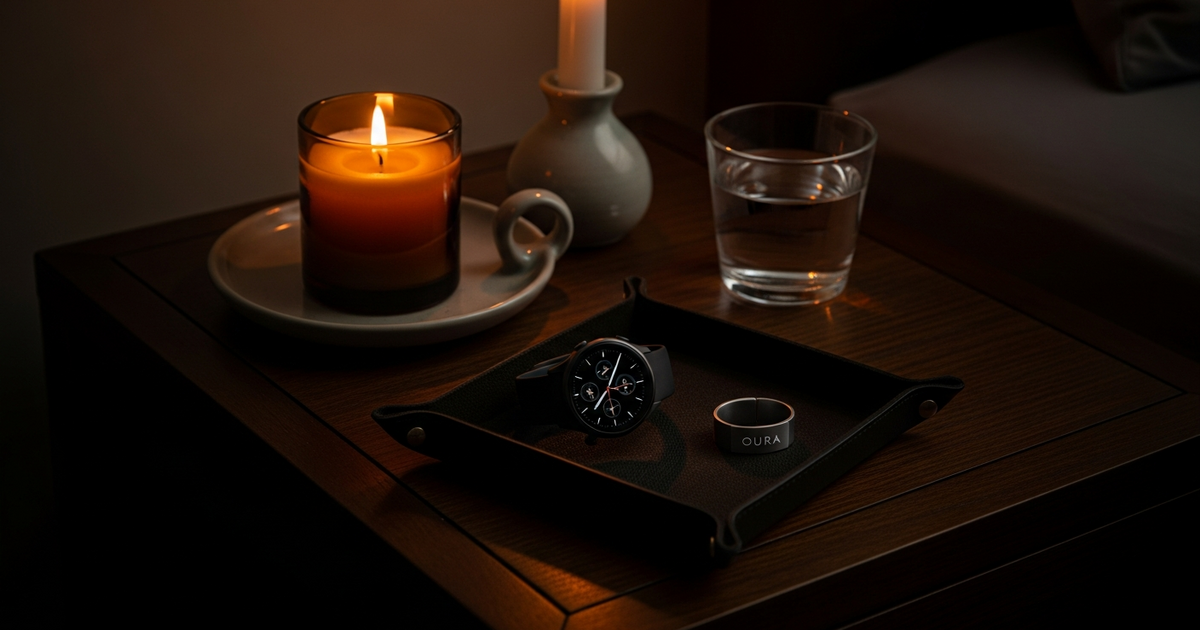
Wearables that track overnight HRV (Oura, Whoop, Apple Watch) can show you this pattern. Consistently smooth overnight HRV curves = good sleep architecture. Jagged, variable curves = fragmented sleep.
What Tanks Your HRV (and Your Sleep)
Several common factors crush HRV — and understanding them explains many "mystery" bad sleep nights:
Alcohol: Even 1-2 drinks reduce overnight HRV by 15-30%. Alcohol metabolites keep the sympathetic system partially activated during sleep, which is why you sleep "heavily" but wake unrested. HRV data makes this crystal clear — your worst sleep nights almost always correlate with alcohol consumption.
Late caffeine: Caffeine consumed after 2 PM can reduce evening HRV for 6+ hours. A 2013 study in the Journal of Clinical Sleep Medicine showed that caffeine 6 hours before bed still measurably impacted HRV and sleep quality.
Screen exposure before bed: Blue light and stimulating content both suppress parasympathetic activation. HRV measured after 30 minutes of phone use shows consistent decreases compared to 30 minutes of reading or breathing exercises.
Intense evening exercise: While morning/afternoon exercise improves HRV over time, intense exercise within 2-3 hours of bed temporarily elevates sympathetic activation. The body needs time to transition from exercise-induced arousal back to baseline.
Unresolved stress: A difficult conversation, a worrying email, or unfinished work — HRV drops measurably after stressful events and can take 30-90 minutes to recover.
How to Improve Your Evening HRV
Every technique that improves HRV is essentially a nervous system reset technique:
Breathing exercises: The single most effective acute HRV intervention. 5 minutes of slow breathing with extended exhalation (4-7-8 pattern) can increase HRV by 20-40% within the session. The effect is immediate and measurable.
Sound healing: Low-frequency audio — particularly delta and theta tracks — improves HRV during listening. A 2020 study found that participants listening to singing bowl recordings showed significant HRV improvement compared to silence.
Meditation: Even brief meditation (10 minutes) improves HRV. Regular practice (daily for 2+ weeks) improves baseline HRV, meaning your resting-state parasympathetic tone increases permanently.
Cold exposure: Brief cold exposure (cold shower finish, cold water on face) produces a vagal activation spike that elevates HRV for 30-60 minutes afterward.
Consistent sleep schedule: Circadian regularity directly influences autonomic balance. Same bedtime and wake time (including weekends) improves baseline HRV within 1-2 weeks.
Regular aerobic exercise: The strongest evidence-based long-term HRV builder. 150 minutes/week of moderate aerobic exercise improves resting HRV significantly within 4-8 weeks.
Using HRV as Your Sleep Coach
If you have an HRV-tracking wearable, use it as an objective feedback tool:
Track evening HRV daily. Note the number before you start your pre-sleep routine and after.
Correlate with sleep quality. After 2 weeks, you'll see your personal pattern: what HRV threshold predicts a good night vs. a bad one.
Test interventions. Does breathwork raise your evening HRV? Does skipping alcohol raise it? Does sound healing raise it? The data tells you which practices actually move the needle for YOUR nervous system.
Watch the trend. Day-to-day fluctuations are normal. The 7-day and 30-day trends are what matter. A rising trend means your nervous system is becoming more resilient. A flat or declining trend means something is chronically activating your sympathetic system.
You don't need a wearable to benefit from nervous system practices. But if you have one, HRV transforms sleep improvement from guesswork into data-driven optimization.
The Number That Tells the Truth
HRV doesn't lie. You can't fake it. You can't convince yourself your nervous system is calm when it's not — the millisecond variations between your heartbeats tell the real story.
And that's what makes it powerful: it's objective feedback in a domain (sleep, stress, nervous system state) where subjective perception is notoriously unreliable.
Use it to understand your pattern. Use it to test what works. And use it to watch your nervous system strengthen over weeks and months of consistent practice.
---
This is part of our guide on [Your Nervous System and Sleep](/blog/nervous-system-reset-for-sleep). Explore the full guide for the complete science behind nervous system reset techniques for sleep.
Start Sleeping Better Tonight
Join 14,500+ people who've transformed their sleep with healing frequencies, delta wave entrainment, and our progressive 21-night program.